What’s love got to do with it? In a previous post, we explored how to cultivate a love of learning in children. In this post, we will take it a step further in exploring the relationship between love and learning by looking at techniques and outcomes of how we educate our children.
First, we have to ask what our goal is. Is it to raise a materialist whose thinking calcifies and dies in the graveyard of intellectual abstractions divorced from reality? Or, is it to raise holists whose thinking remains alive in the meadow of living concepts won from the actual phenomena of the world? One of these paths divorces the self from the world, leading to alienation and meaninglessness. Is it any wonder the youth of today experience a mental health and meaning crisis unlike any in recorded history? This is not an arbitrary fact. It is entirely connected with how we raise and educate them.
The other path leads to the realization that the world is a monad, that “I” am not separate from it. From this, flows a love and connection to all that is. What do you want for your child?
How to Stimulate Love and Learning
Our curriculum at Enkindle Academy is based in the Steiner approach which is phenomenological in nature. This fundamentally means we learn directly and intuitively from the phenomena of the world. This could be the growth and blossoming of a flower, the facts of a period in history, etc. In this approach, the teacher’s role is less to tell the students what to think. Instead it invites them to discover for themselves what the world’s geniuses have discovered and even new things as well.
From start to finish, we draw students into a relationship with the actual world around them through observation, reflection, story, art, and hands-on engagement. For example, I ask students in our 5th Grade Botany I block to make a geometric nature mandala. In middle school science blocks like 6th Grade Physics or 8th Grade Organic Chemistry, our students learn entirely through experimentation, recollection, sleep, and then harvesting insight. This process makes use of the natural rhythms of willing, feeling, and thinking to maximize learning.
Throughout this process, textbooks never enter the picture. Actually, the students make their own textbooks through rendering what they learn artistically and then writing about it. The difference between this and the mainstream approach is that our students take a deep interest in the world around them. Thereby, learning isn’t a chore imposed by the state through teachers. It’s a joy because this is, ultimately, their world. We are not indoctrinating them with an agenda-based ideology. Rather, we are stewarding their relationship to life, itself, of which they are a part. Ultimately, we are beckoning them into self-knowledge which they get not by withdrawing inwards but by taking an interest in the world, ironic as that may sound.
So, What’s Love Got to Do with It?
Here, there are two things to say. The first is that feeling and memory are closely connected. That’s because the memory organ, the hippocampus, is located close to the feeling organ, the limbic system, in the brain. Love – and feeling in general – is therefore necessary to arouse in order for students to remember what they learn. Think back upon your own life. Your strongest memories probably have a strong feeling associated with them. It’s not always pleasant, but you can see how this works. This is why art is so important in the learning process. When we make beautiful art or music, etc. with our topics, they stick. This is also why jokes and even off-the-wall references also work. For example, did you hear why carbon and oxygen broke up? It’s because their relationship was pretty toxic, especially for everyone around them.
Jokes aside, the second point is that loving and knowing are the same thing. If you truly love someone, the best gift you can give them is your undivided attention. That means more than just about anything else, because when you turn your soul towards them with the sincere desire to know them on their terms, loving words and deeds naturally follow. The same is true for everything in the world. If you would know something, first love it; and, if you sincerely study something, you will inevitably love it. At the least, you will gain some measure of compassion for it, even if that being is not a particularly likable one. I would even venture to say that just knowing someone can help them in ways unimaginable.
So, Who Are We?
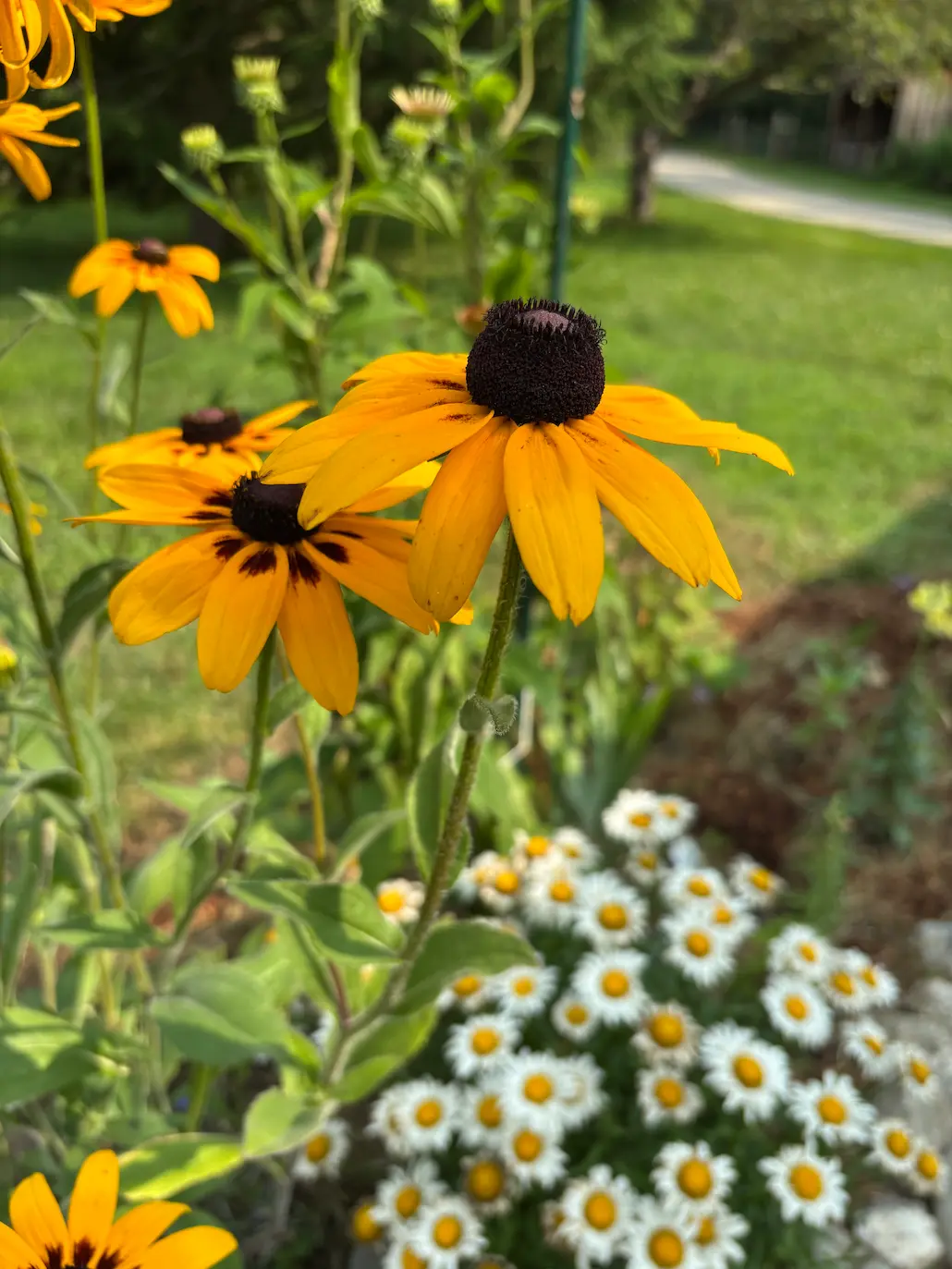
Consider the leaf and blossom of the black-eyed susan image above. Although we can distinguish leaf and blossom from one another, they are part of one and the same process which cannot be separated. They are simply distinct expressions of the same living, evolving phenomenon. In the same way, we and all things in the world are likewise expressions of one big, unbroken process of evolution called creation. We are distinct, yet not separate. One life underlies all. To know and identify with that one life gives us freedom from all the ailments of egotism.
When we educate our youth in the right way, they will one day look upon the world and say to it, “I am,” and look back upon themselves and say, “You are.” This golden experience represents the flowering of consciousness. It occurs when I can find myself and others, yet look upon my own ego with objectivity. Don’t you want that for your children? It starts with establishing the relationship between love and learning.
Parent Mentoring
We are considering offering parent education here at Enkindle Academy. This could take the form of live parent training groups, individual mentoring, short blocks on how to teach various subjects like math, history, language arts, etc. It could also take the form of families submitting student work for feedback on how their student is doing. We are open to whatever other suggestions you have. If this interests you as a homeschool parent, please Contact Us, and let us know your wishes.
How Else to Connect
Enkindle Academy offers prerecorded and live lessons for students in grades 5-9, encouraging students to deepen their reverence for nature and adopt sustainable, regenerative attitudes towards her. We teach all academic subjects plus fine arts, creative writing and language arts, and empowerment groups for teens.
Our Creative Writing Class meets weekly. We are always accepting new students, and enrollment is growing rapidly. When we have enough students, we open up new sections. Visit us at the following link to signup or get more info: https://enkindleacademy.com/live-creative-writing-for-youth
Our Teen Empowerment Class also meets weekly. We are always accepting new students. If you want your youth in a tightly knit, warm, and welcoming group of peers with a loving guide who keeps them focused on the good, beautiful, and true come check us out. Visit us at the following link to signup or get more info: https://enkindleacademy.com/live-teen-empowerment-class.
Leave a Reply
You must be logged in to post a comment.