Advent refers to the four weeks leading up to Christmas. In this post we’ll explore the meaning of Advent. However, this is not intended for Christians only because the principles herein are universally applicable. I use the symbolism of Advent as useful imagery to make important points, but my intention is to speak beyond the boundaries of religion. It is, for example, not without meaning that Christmas was placed around the time of the winter solstice, for this corresponded with the pre-Christian celebration of the new birth of the sun around the Winter Solstice. The Christian motif of the Virgin Mary and Jesus is also a pattern reflection of Isis and Horus, Cybele and Attis (Asia Minor), Devakī and Krishna (India), and others. These symbols span cultures and are not arbitrary.
Consisting of four weeks, Advent honors the four kingdoms of nature and cardinal virtues. This year, they fall as follows:
- Week of November 30 – Mineral/Justice
- Week of December 7 – Plant/Temperance
- Week of December 14 – Animal/Courage
- Week of December 21 – Human/Wisdom
This being the first week of Advent, I awoke this morning to the uncomfortable feeling of needing to bring justice to an issue. I had not thought about it for a while, and I was awestruck when it came virtually out of nowhere during this week. Kind of spooky, actually.
So, how do we practice the meaning of Advent?
While we can practice the meaning of Advent in our own lives as adults, since this is a homeschooling website, we will speak to how to bring it to children. Many people use an Advent wreath, lighting each of the candles as the weeks pass which brings beauty and reverence into the house. For younger children, we can tell stories corresponding with each week’s theme. Here is a good resource for those. For older children, we can give them a journal prompt, have a dinner table discussion, and/or ask them to find an object each week that corresponds to the stated virtue. What does justice look like in a teenage life? What about temperance (with smartphones, for example)? Courage (with peers)? Wisdom? Even bringing simple daily awareness to these themes can help your family live into them.
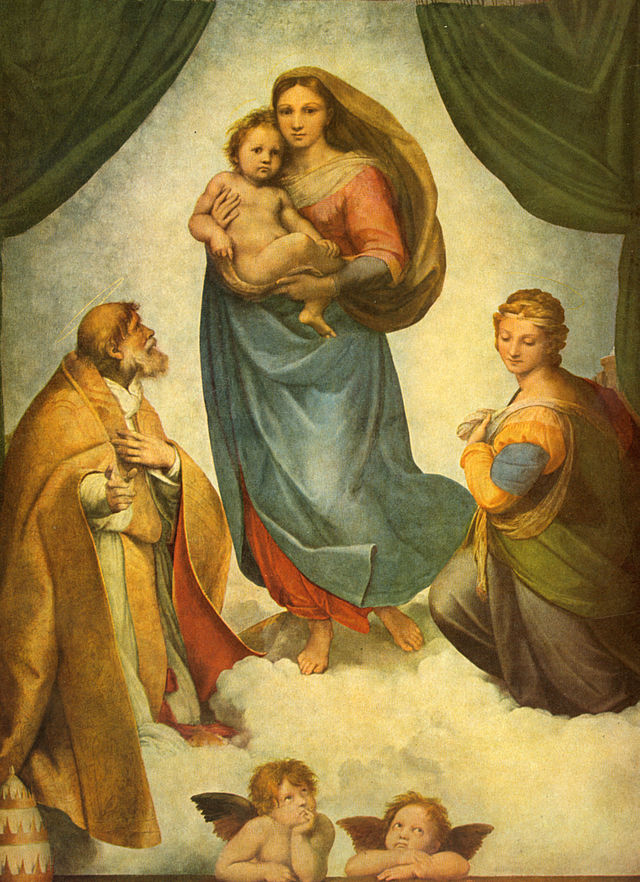
A meaningful family celebration of the season, however, begins with deepening your own understanding, for action flows from knowledge. Advent is a time of purification. The party atmosphere should be kept at a minimum. I’m not saying decline invitations, but be mindful of the work to be done and don’t lose yourself in the glitz. The holidays can be stressful when we unnaturally pack so much into a time that should be quieter and more reflective. Advent is a time to confront one’s own shadow so as to purify one’s soul to become like the Virgin Mary. She is the Divine Sophia. Look at the image above, and the picture of the Madonna explains everything. Is your inner life as innocent as she is? If not, there’s work to do.
The Madonna and Child and Human Soul-Spirit
Esoterically, the Madonna corresponds to the human soul. When it becomes pure enough, it gives birth to the Higher-I, symbolized in the Christ-child. (That is why I say one need not be Christian to appreciate this symbolism – because the process is universal, even if one uses different language. It is the same process as occurs over time in yoga meditation, for example, where the mind becomes pure enough to commune directly with the Higher Self.) Advent is the time to purify our souls to give birth to the intentions of the Higher-I starting the night of Christmas Eve and lasting the 12 Holy Nights until Epiphany on January 6. It’s like a 12-day New Year’s intention setting.
The Meaning of Advent in Present and Future Time
According the spiritual science, we are in a Parcivalian age of confronting the “devil” of our own egotism to freely develop self-awareness, moral discernment, and ethical individualism. Egotistical individualism becomes ethical individualism. That is to say, one who is unwillingly to go against the grain of the mainstream to stand for what is right. In time, this ethical individualism will lead to ethical communities which freely organize around truly human themes. In my opinion, the days of exoteric religion are numbered. The spirituality of the future will be free and not coerced. It will become mystical and non-dogmatic. People will want to know, not just believe.
The Meaning of Advent in Pre-Christian Time
Although it was not called “Advent” in pre-Christian times, the meaning of Advent then was not so different. Ancient people understood that outer darkness was an opportunity to commune with inner light. For example, the Germanic festival of Yule centered around the theme that light returns after the deepest dark. They saw in the outer facts of nature a reflection of what lived within the human soul.
Religious Imagery is Nature Imagery
The new spirituality is a universal one free from religious dogmas. What matters now is not what religion we adhere to or not. Rather, it is the transformation we undergo to become truly human. That is to say, it is that we transform what is base in us – the compost, if you will – into what is virtuous, like a rose blossom. The images from various religious traditions are powerful portals to living realities of soul and spirit. They offer us opportunities to educate our souls as to what we are to do. These images also express in picture form processes which are hard-coded into outer and inner nature.
Week 1: The Stones – Justice
Justice is the ground of moral life, just as the stones are the ground of outer reality. It’s a question of where the buck stops, so to speak. That is why the virtue of justice is associated with stones. We have to become morally upright before the other virtues can function. So, the first week is about righting the wrongs in your life. Where do you need to take responsibility to rework or repair things?
Week 2: The Plants – Temperance
Plants are symbols of life. They are the mineral world come to breathe and grow. Now, think of all the elements needed for plant life – light, water, soil, warmth, etc. All of these the plant requires in a balance. Too much or too little of one or the other can lead to illness and even death. Plants have a natural lawfulness that they can’t help but follow. From their perspective, therefore, they can only act with temperance.
Humans, by contrast, have desire and ego. We can disobey our natural lawfulness and go overboard in a variety of ways. We can eat too much, drink too much, and we can also act rashly. Our tongues can get the better of us when we lash out in unrestrained anger or irritation.
Temperance is the practice of restraining egotistical desire. This week is about taming what in us goes overboard in all ways with the goal of fostering healthy – physical, soulful, spiritual, social, etc. Best wishes on your journey of transformation this week and beyond.
How We Can Help
Enkindle Academy offers prerecorded and live lessons for students in grades 5-9. We teach all academic subjects plus fine arts, creative writing, and empowerment groups for teens. We also offer 1-on-1 tutoring on all subjects including fine arts. Visit our website for more info and for free sample lessons. Remember to subscribe for weekly updates, tips for homeschooling, and special offers.
Leave a Reply
You must be logged in to post a comment.