In this post, we discuss the right and left brains in education and how this understanding can inform how we educate our children. We will also draw connections to Artificial Intelligence (AI) which has ramifications for how we raise and educate our young.
Neuroscientific researcher Iain McGilchrist explains the right and left hemispheres differ in how they attend to the world. In other words, how they pay attention to the world’s stimuli is different, and for good reasons (McGilchrist, 2009). The left brain quantifies, names, and defines, where the right brain qualifies. When looking at a rose, for example, the left brain names its parts, identifies its species, analyzes its structure and maybe even its chemical composition. The right brain senses its beauty, life force, and sees how it relates to the earth, sun, water, air, and so forth. The left brain parses our experience into parts whereas the right brain stitches those parts into an interconnected whole.
Logic is a left brain tool, one Aristotle did a great deal to develop. However, as powerful as Aristotle believed logic to be, he also admitted it could not be used to grasp reality’s first principles (Aristotle, 1984, Posterior Analytics, II.19, 99b15–100b17). Something more was needed. In modern language, we would call that “direct experience.” Thus, we have the two complementary ways of seeing the world hardwired into our neurology.
Comparing and Contrasting Right and Left Brain Hemispheres
One way of understanding how the left brain functions is to compare it to AI. In Large Language Models (LLM) like ChatGPT, AI assigns statistical values to words and phrases. When you ask it a question, it analyzes your words and calculates the answer you most statistically want to hear. In that sense, AI is no more intelligent than the minerals it’s made of. It responds not from experience but from calculation according to how its been trained (which, by the way, necessarily inculcates it with the biases of its trainers – but that is a post for another time). AI does not understand the meaning of what it calculates. In likewise, people with right brain damage can struggle to recognize how their behavior impacts others (American Speech-Language-Hearing Association [ASHA], n.d.). In other words, the left brain cannot see the forest for the trees.
If the left brain quantifies, the right brain qualifies. This is the place where meaning is found and created. Human capacities for art, religion, relationships, emotion, intuition, metaphor, and symbolism, etc. live in the right brain. However, injuries to the left brain can result in challenges with language, analytical reasoning, sequencing, calculation, and certain aspects of voluntary movement (Corballis, 2014). The right brain cannot weigh, measure, and calculate.
It goes without saying that both are necessary.
Yet, Who is the Master?
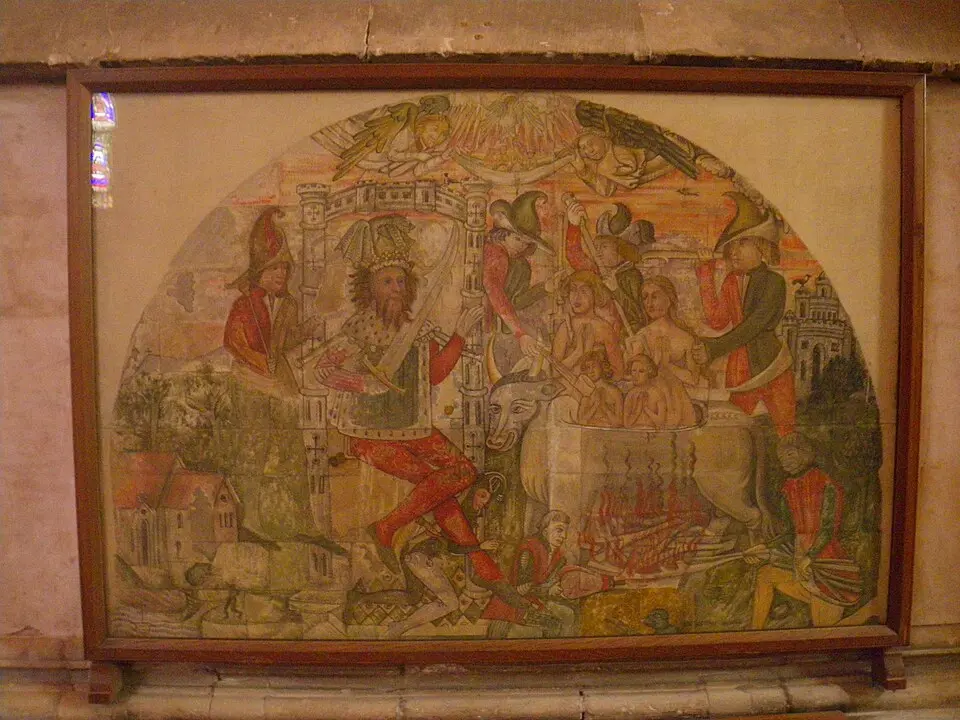
This is a question of monumental importance in modern life, and it bears on how we understand the right and left brain in education. What we could call “right brain consciousness” dominated human life most of history. In Saving the Appearances: A Study in Idolatry (1957), Owen Barfield coins the term “original participation” describing how earthly humanity felt itself at one with the world (Barfield, 1957). If you look at ancient through medieval art, you will notice how flat and two-dimensional it is, like this piece.
With the Renaissance, however, a sudden shift occurred and art moved into perspective. The human started extracting him/herself from the world, as indicated in the “School of Athens” by Raphael. Notice how the viewer has stepped out of the scene and no longer participates directly. Barfield’s “original participation” died during the Renaissance.
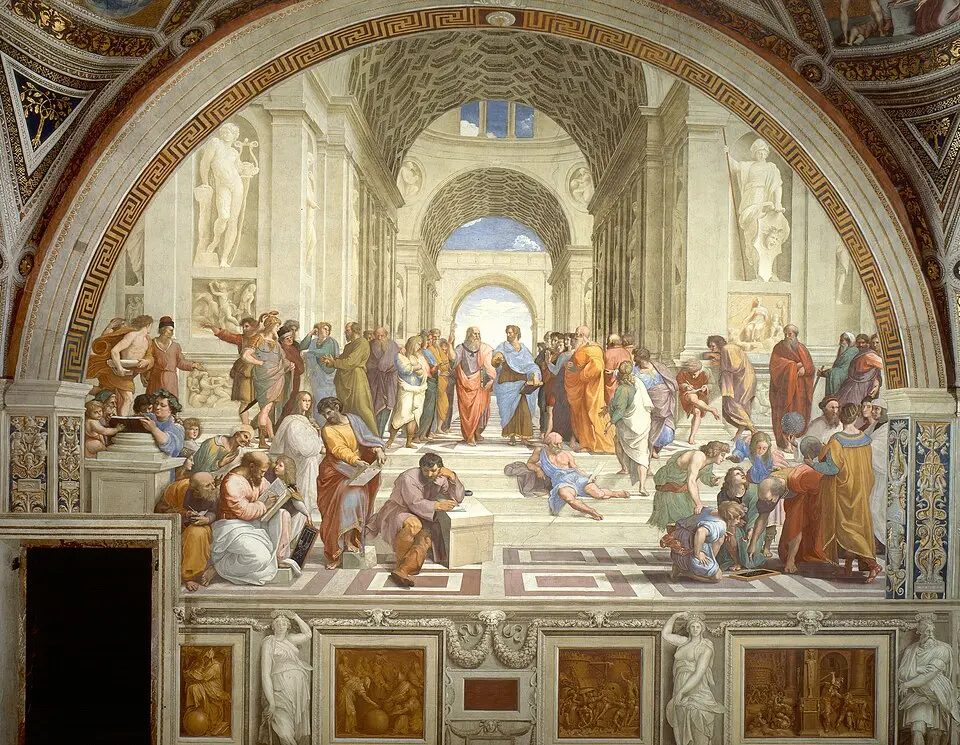
This shift in consciousness coincided with the Enlightenment and the emergence of a more calculative, left-brain-dominant, empirically-based worldview.
Our modern age has taken this to a far degree allowing us to master the atomic, mineral world like never before. AI is perhaps the clearest outgrowth of this new capacity. Yet, though AI is calculation on steroids, it cannot intuit the value of what it calculates. For that, it would need a right brain, so to speak.
Similarly, discovering what we want in life comes from the right brain. Then, the left brain helps us figure out how to get it.
Right and Left Brains in Education: Ramifications
Understanding the functioning of the right and left brains in education matters a great deal because it tells us how to properly integrate these two functions. Here’s an example of how this works. One of the things we do in our weekly Teen Empowerment Class is keep a goals journal. As I explain to them, the right brain, or “heart,” if you will, tells you what your goal is and why it matters. For example, maybe it is to master a certain dance move so you can tryout for a big part. The left brain, or “logic,” creates the action steps to achieve it. This capacity also helps you review the past week and grade yourself to see how well you did on each action step. So, for example, you set yourself a practice time of 15 min. to be done 4 times a week towards mastering your goal. Success starts with the right brain and then uses the left brain to serve its ends. Heart is the master. Intellect is the servant.
When it comes to teaching school subjects, a rule of thumb is to teach from whole to parts which harmonizes with this understanding. So when we teach sculpture, for example, start with whole form and remove what is not the final form. In other words, if you’re sculpting a cow, start with a sphere and remove everything that’s not the cow instead of starting with a bunch of parts and bringing them together to form the cow. This sounds so subtle and insignificant, but it matters in how we teach our children, if we seek to preserve the right brain in an age of extreme left brain dominance.
Another application is how we teach math. Take fractions, for example. Start with the original unity of the world and explain how all its various parts – trees, animals, humans, and so on – emerge as “fractions” of that original unity. Then, teach fractions. Once again, this whole-to-parts teaching communicates something unspoken yet profound about meaning and where to find it.
The Journey of Human Life
Human life is a journey from wholeness to wholeness with an experience of division in between. On earth, both are necessary, but we have to understand who is master and who is servant. Children start in that wholeness and fall from it as the intellect develops, especially in adolescence. An education based in the true science of the human being starts from the right brain and educates the left brain to serve it, rather than the other way around. If we educate them the right way, they will retain that right brain component even as we educate the left to allow it to be effective in the world, and that is the whole point of education: to help human beings manifest in earthly form the gifts they bring from the spiritual world.
That’s why our curriculum is based in the arts. It’s not because we’re trying to make professional artists out of our students but because it flows from an understanding of how to properly integrate the right and left brains in education. The only way to teach the left brain is to connect it with what has meaning for the right. Even when we teach subjects like math and science, we connect rigorous academic concepts to the reality of the whole so our students never lose sight of the sublime, beautiful reasons they are learning these things. If we do it right, we will hear from students as one of our English Through Creative Writing students recently said, “It’s very rigorous but very enjoyable, too.”
Please check out a free sample lesson to see how we work.
How to Connect
Enkindle Academy inspires young minds using a regenerative, Steiner-based approach to homeschooling. We offer prerecorded and live lessons for students in grades 5-9, encouraging students to deepen their reverence for nature and the living reality that permeates it. We teach all academic subjects plus creative writing and language arts, empowerment groups for teens, and soon to add fine arts.
Signup for a free sample lesson now.
References
- McGilchrist, I. (2009). The master and his emissary: The divided brain and the making of the Western world. Yale University Press.
- Aristotle. (1984). Posterior analytics (J. Barnes, Trans.). In J. Barnes (Ed.), The complete works of Aristotle: The revised Oxford translation (Vol. 1). Princeton University Press.
- American Speech-Language-Hearing Association. (n.d.). Right hemisphere disorder. ASHA Practice Portal. https://www.asha.org/practice-portal/clinical-topics/right-hemisphere-disorder/
- Corballis, M. C. (2014). Left brain, right brain: Facts and fantasies. PLOS Biology, 12(1), e1001767. https://doi.org/10.1371/journal.pbio.1001767
- Barfield, O. (1957). Saving the appearances: A study in idolatry. Faber and Faber.
Leave a Reply
You must be logged in to post a comment.