
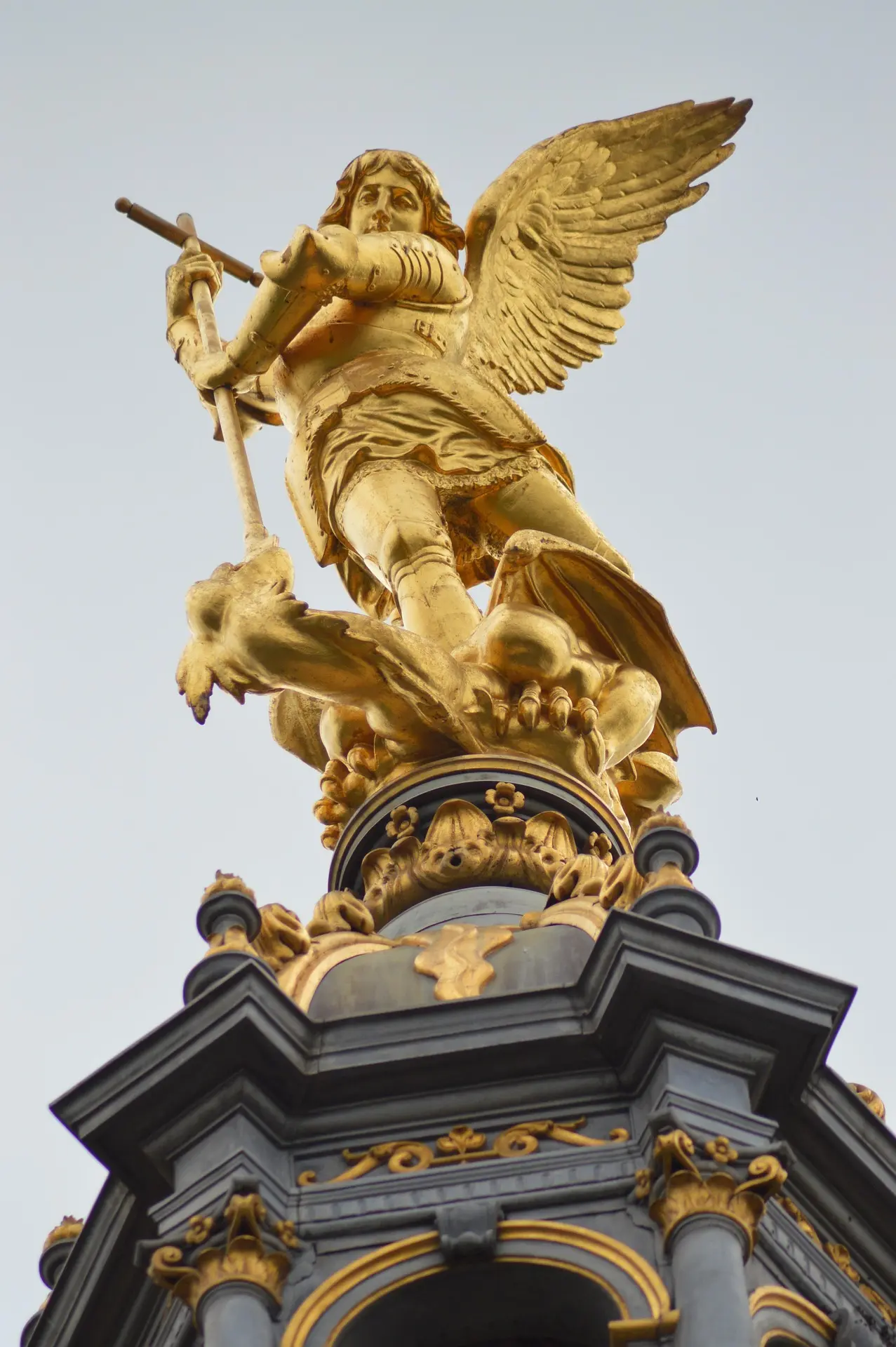
Michaelmas approaches – September 29. This is arguably the most important festival in the Waldorf school year as it symbolizes the important human quality of courage. In this post we will discuss the symbolism and importance of this holiday as well as how we go about preparing for Michaelmas.
First, let’s consider what’s happening in outer nature at this time, for the outside and inside of us are not separate. In summer, it’s easy to feel good and easeful. We spread out, go on vacation, and relax our schedules. We can so easily lose ourselves in the beauty of flowers, the joys of beaches, and warm nights walking on the boardwalk. At the same time, summer is a time where life can deceive us. We adults know how many summer romances, perhaps born at camp, “seemed like a good idea at the time,” only to prove disastrous when reality set in. Yes, we all know what I’m talking about. Summer can carry our discernment away on its warm winds.
This tendency to lose ourselves in summer bliss is curtailed by Michael’s correcting sword. It’s not comfortable to return to a sobriety of thought and perception. That’s why it’s also called the Day of Courage. Michaelmas is the gateway to the season of darkness, as just a few days before, the nights have become longer than the days in the Northern Hemisphere. Outer nature withers and dies, reminding us of the mortality of all things in the created world. If we look deeply into such realities, they engender fear. We may be spiritual beings, but living on earth makes it easy to forget that. As Rudolf Steiner said in describing candidates for initiation into the ancient mysteries, “They became thoroughly acquainted with the sensation that a penetration into man’s inner being…must instill fear (Steiner, 1921/1985, para. 8).”
So, How Do We Celebrate Michaelmas?
Just like any challenge in life, we must learn to embrace this seasonal energy shift and turn it to the good. We do this be consciously celebrating it. Children are especially sensitive to the seasonal changes, even through the grade school years, because they don’t have such a hardened ego separating them from nature yet. They still live more in the periphery than the point. That’s why seasonal festivals and curriculum themes can help them. Indeed, most students love such celebrations!
So when preparing for Michaelmas, consider age-appropriate activities. For younger children, crafts are ideal. For example, you can make dragons, knights, princesses, farmers, and other related figures out of many different materials. You can use wool, felt, popsicle sticks, cornhusks, etc. This is where older and younger children can come together. For example, needle felting a knight is more appropriate for middle schoolers for safety reasons, so the older ones can make such things for the younger ones.
Harvesting, cooking, and baking is another way to draw the whole family together to celebrate the season. For example, you can go apple and pumpkin picking, make apple crisp and pumpkin pie together, and bake dragon bread. Whatever puts your children directly in touch with what nature is doing at this time is good. If you feel creatively inspired, and you have a garden, you can harvest root crops, and as you put them in winter storage, tell a story of how these hardy vegetables make it through the darkness unscathed. With a little imagination, you can accomplish a great deal, especially with the younger children.
Preparing for Michaelmas in Your Curriculum
As children get into the grade school, preparing for Michaelmas can include more artistic activities, such as watercolor paintings, chalk drawings, and sculptures of related themes. It’s always helps to tell stories alongside these activities to infuse them with soul. Here are some curricular suggestions:
- Grade 5 – Tell stories of dragon myths from ancient history like Indra and Vritra (India), Ahura Mazdao and Ahriman (Persia), Marduk and Tiamat (Babylon), Ra and Apophis (Egypt), Apollo and Python (Greece). There are dragon slaying/taming myths from virtually every major world culture – that’s interesting, isn’t it?
- Grade 6 – St. George and the Dragon. This classic tale paints a picture of knightly chivalry and courage.
- Grades 7 and 8 – The ideas of courage and dragons can become more inward and conceptual. You can continue telling them stories of courageous deeds, but now you can connect it with more modern times. For example, you can talk about Galileo taking on the dragon of church dogma. In 8th grade, you can talk about Washington’s courage against the dragon of the British Empire, and so forth.
It is also good to be part of a festival on Michaelmas. These are common at Waldorf schools, and many will allow outside community members to participate to some degree. In lieu of that, you can celebrate it at home with your children with stories, art, rituals, such as saying an Archangel Michael verse at night before bed, and don’t forget the songs. There are so many out there which beautifully capture the feeling of the season. Don’t neglect the music!
Make Good Use of This Time
Our modern culture with all its technology has so separated us from the earth and the gifts she has for us. She doesn’t merely nurture our bodies with substance, she also nurtures our souls and spirits if we consciously retain our communion with her. Seasonal festivals like Michaelmas help us do that and deliver a regenerative education to our children. So, don’t pass this one over. Do something sacred to honor it this year.
New Directions and How to Connect
Enkindle Academy regenerates human culture by inspiring young minds using a Steiner-based approach to homeschooling. We offer prerecorded and live lessons for students in grades 5-9, encouraging students to deepen their reverence for nature and the living reality that permeates it. We teach all academic subjects plus creative writing and language arts, empowerment groups for teens, and soon to add fine arts.
Signup for a free sample lesson now.
References:
- Steiner, R. (1985). Cosmosophy: Vol. 1 (M. Klein & A. Wulsin, Trans.). SteinerBooks. (Original lecture delivered September 23, 1921).
Leave a Reply
You must be logged in to post a comment.