
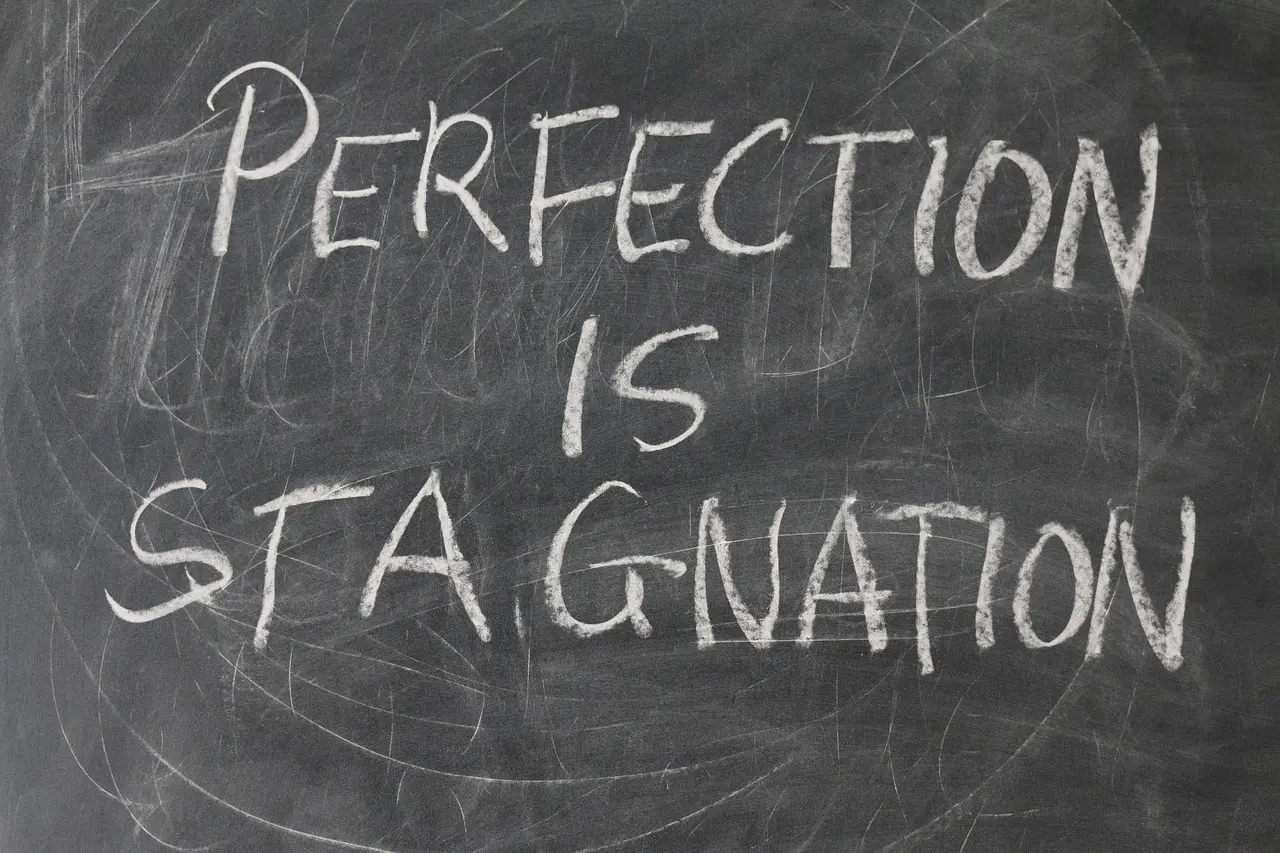
Do you struggle to overcome perfectionism in your children, like trying to pull out a pernicious weed with a deep taproot? Today, we’re going to talk about what causes this trait in children, which can be debilitating, and what you as parent or teacher can do about it. (Listen to this post below.)
I had a student back in Asheville who was intelligent and virtuosic in the arts. Experiences of beauty, like a blossoming rose, moved her so deeply she celebrated these experiences in painting and song. Yet, perfectionism afflicted her like a parasite feeding on her best efforts. Her self-concept was caught in the polarity of good and bad, like a fly in spider’s web. Such a fixed mindset (as elaborated by Carol Dweck’s work) measures the self according to fixed standards. You either pass muster or you’re a failure. There, mistakes reveal a tragic lack of self-worth.
The Paradox of Standards in Overcoming Perfectionism
Self-evaluation always comes in relationship to a standard. Some of these are internal and irrational, like the inability to see value in even the most striking work (like Georgia O’Keefe who destroyed much of her own work). Others are imposed or communicated from the outside, like academic standards. The aforementioned student was also highly dyslexic, which is part of why she was so brilliant. She saw the world in ways most of peers could not. Yet, according to the academic “standard,” she was a failure, for her reading and writing skills lagged years behind her peers. This negative self-perception affected not only her reading/writing, but also her art. Every mistake became a big problem.
Why do standards exist? Are they there to guide our path at each age of development? Are they meant to evaluate and judge our students, to fix them to an unchangeable place in the pecking order of talent? French psychologist Alfred Binet developed the Binet-Simon test, aka, the IQ test, around the turn of the 20th century. Its purpose was to identify students needing support in school by measuring the ability to learn. The test did not measure what students already knew. In other words, the IQ test told teachers where students needed to grow. Later, eugenicists perverted its function to measure fixed intelligence. In other words, they took what was intended to support a growth mindset and twisted it to serve a fixed mindset about human potential, as Carol Dweck would say.
So, What is a human being, Anyway?
How do we use this information to overcome perfectionism in children? Well, does it make more sense to think of ourselves as human beings or human becomings?
It makes a difference. The IQ and other “standards” are useful in giving us information about where people are. For example, I used to test my students at the end of a block (and that told me how I needed to alter my teaching). However, if we think of our students, our children, and ourselves as captured or frozen in time by those assessments and we communicate to them, “Pass” or “Fail,” we implant a fixed mindset in them. Fixed mindsets are the basis of perfectionism.
How do We Overcome Perfectionism in Children?
A quote attributed to Goethe says, “Treat people as they are and you make them worse. Treat people as they ought to be, and you help them become what they are capable of becoming.” How can we view our children and students as “becoming” and then reflect that in our feedback to them? For example, if we have an ADHD child doing annoying things, are they an annoying person? Or, are they in process of learning to master themselves? How do we first change the way we think about them and then communicate that through our words and deeds? Similarly, with our perfectionist student, how do we reframe her mistakes as opportunities to grow?
Here’s my advice: learn neither to criticize nor praise what your children produce. Instead, focus on their efforts to produce it. It doesn’t matter what gifts or challenges our students come in with. What matters is the effort they make to grow and get better whether in school, sports, arts, music, theater, behavior, etc. Be wary of academic standards, for they are not the be-all end-all. I have known countless students who met all the standards and grew up to be creative zeros as adults. By contrast, I’ve known many who never met the “standards” who are highly successful as adults. Strive to break the tendency in your children to have to perform and look good. Becoming great is for the fools, not the (excuse my language) badasses.
Many of the most talented children are simultaneously the most afflicted. Yet, we can help them overcome perfectionism by the mindset we adopt and how we communicate that to them through our words and deeds. May all the good forces in the universe be as wind in your sails in this endeavor.
How We Can Help
Enkindle Academy offers prerecorded and live lessons for students in grades 5-9. We teach all academic subjects plus fine arts, creative writing, and empowerment groups for teens. We also offer 1-on-1 tutoring on all subjects including academics and fine arts. Visit our website for more info and free sample lessons. Remember to subscribe for weekly updates, tips on homeschooling, and special offers.
Leave a Reply
You must be logged in to post a comment.