
Why is it so important to emphasize art in Waldorf Education? Or, in any education for that matter? Why not just give them textbooks? To explore this question, let’s first acknowledge that a true education educates the whole being. Would you send your children to a school whose motto is, “We only educate the head!” I hope not. Such a thing sounds horrific. At the least, you would feel something is off about such a school because we are not creatures merely of thinking but also of feeling and willing. To educate our children in an overly intellectual way leaves no stamp, therefore, of love for learning on their souls. More and more parents are waking up to this fact.
The Role of Play in Learning
The 18th century German idealist Friedrich von Schiller made a penetrating observation, “Man only plays when he is in the fullest sense of the word a human being, and he is only fully a human being when he plays.” I grew up playing drumkit, and Dennis Chambers was one of the best drummers around at that time. In an interview with him, he said something like, “I never practice. I just play.” Forgive that I don’t have the reference – it was many years ago, but it stuck with me. I wondered how “play” could build a man into a musical genius. Now, perhaps, I have a better idea.
Schiller’s recognition had a major impact on later thinkers like Rudolf Steiner, who created Waldorf Education. This idealist recognized the extraordinary contribution of play to the learning process, as well as its humanizing effects. A machine cannot play because it has no intrinsic motivation of its own. Humans play because we have a destiny calling to us from the future. In play, we discover what we love which is the gateway to finding out who we are. It also engages our willing and feeling together with our thinking. We find our whole selves by playing. We become human by playing.
It is for that reason that our Waldorf Education should be playful, and art in Waldorf Education is, therefore, non-negotiable.
Head-Only Education
Textbook education speaks primarily to the head. Yet, the head is only a part of our being. It is a quiet tragedy that our modern materialistic culture places so much emphasis on the head. This intellectualism is a grotesque, rather dominant force of modern discourse.
Yet, if you think about what the head actually does, it perceives and reflects the world. It doesn’t actually engage it directly. The head is like a philosopher who lives deep within a cave. Indeed, the brain is enclosed within the hardest bones of our body and has no direct contact with the outside world, whatsoever. This is as it should be, and it allows the brain to reflect the world in clarity. It also, however, separates oneself from the world. By virtue of our heads, we are withdrawn from reality. What appears in the head isn’t reality but only its semblance.
The reason a materialistic culture like ours elevates the head above all else is because materialism, itself, is concerned only with the semblance of reality. In other words, what’s on the outside rather than on the whole picture. It mis-takes the tip for the whole iceberg. Therefore, how could an intellectual-only education ever convey the reality of the world? For that, we have to engage the willing and feeling.
Art in Waldorf Education as a Means of Learning
My greatest inspirations – Rudolf Steiner and P.R. Sarkar – suggest we don’t think with our heads but with our hearts, and these heart-thoughts are reflected in the head. I hope that makes sense. In a spiritual scientific understanding of the human being, the brain is like a mirror. The heart thinks, and these thoughts become apparent in the head. The brain in this model is not an originator but a reflector. Another analogy would be to say the brain is a chalkboard and the heart is the teacher writing on the chalkboard. Did you ever wonder why in our vernacular, people say things like, “I knew the truth in my heart.” Everyday language carries great intelligence within it.
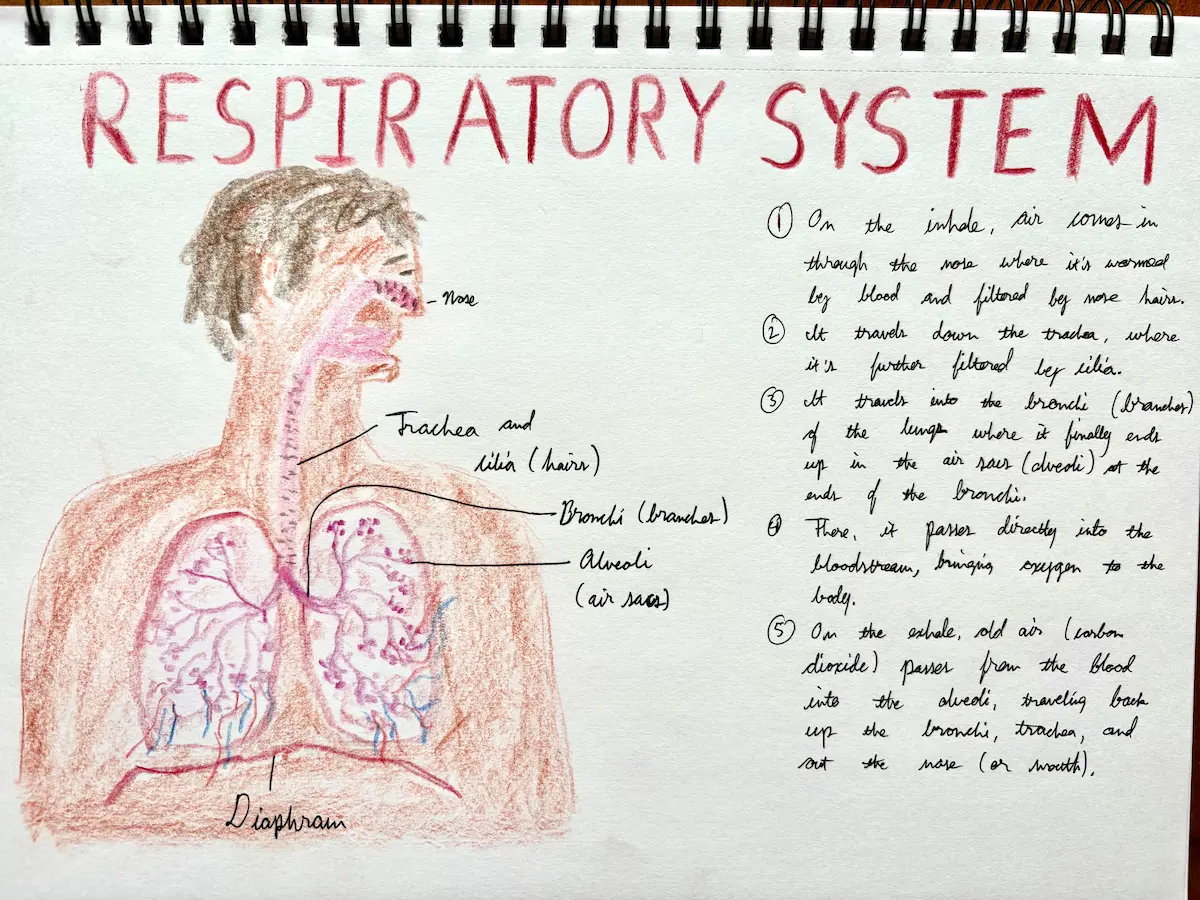
If we believe these spiritual scientists – and I personally think it’s at least worth testing – it stands to reason that what stimulates the heart builds the thinking. Art is the language of the heart. Could it therefore be that the more art we do with our children, the more intelligent they will later become? That is something we can put to the test. We need not be great seers and mystics like the aforementioned. Just try it and observe the results. When, for example, we render the lungs in 7th Grade Physiology like upside down trees within the human body, or when we point out the complementary color scheme of red and green representing the carbon-binding and carbon-releasing processes in human blood and plant sap, respectively, see how this stimulates their thinking to build connections to what they are learning.
An Economical Way Forward
We all want our children to become intelligent. That doesn’t necessarily mean intellectual, per se, but certainly wise, composed, and able to make good decisions in life. Personally, where I think mainstream education has gotten this wrong for a long time is in its attempts to educate the thinking directly. That is an inefficient and maybe even harmful approach. If we want good thinkers, we should start from the bottom up. Art, therefore, becomes essential to the process because it works directly through the limbs (willing) on the heart (feeling) to enrich the head (thinking).
Parent Mentoring
Developing a pedagogical or even Waldorf-based parenting instinct doesn’t happen overnight. It can be challenging to know where to start. That’s why we are considering offering parent education here at Enkindle Academy. This could take the form of live parent training groups, individual mentoring, short blocks on how to teach various subjects like math, history, language arts, etc. It could also take the form of families submitting student work for feedback on how their student is doing. We are open to whatever other suggestions you have. If this interests you as a homeschool parent, please Contact Us, and let us know your wishes. We are actively forming possibilities at present for parent education, so let us know if you want to be a part of it. Thank you!
How We Can Help
Enkindle Academy offers prerecorded and live lessons for students in grades 5-9. We teach all academic subjects plus fine arts, creative writing and language arts, and empowerment groups for teens.
Leave a Reply
You must be logged in to post a comment.