In last week’s post, we discussed the right and left brain hemispheres and how understanding them can help us educate our children for best results. Briefly put, the left brain quantifies, weighs, measures, defines, and calculates. It perceives the quanta, whereas the right brain apprehends qualia. The former sees a $50 bill on the table, the latter imagines how we can treat a dear friend to dinner with it. The right brain sees the interconnection of self and world, allows us to find meaning in life, and perceives the value of what the left brain quantifies. Both are, of course, important. However, the left brain must serve the right if we are to live value-driven lives. Speaking of value, what is it? And, how do we structure our education to raise children to recognize what matters most in life? In this post, therefore, we will elaborate the basis of human values in education.
As I’ve said in the past, materialism can never provide the basis for a system of human values. Why? It’s because materialism lives in the quantitative realm, and human beings are more than matter. (What that “more than matter” is, is a topic for debate and a post for another time. Suffice it to say, given that our neurology seeks not just material understanding but immaterial meaning is, itself, supportive of this conclusion. More on that later.) Modern science, materialistically oriented as it is, thrives on quantifying, calculating, and reducing the world to its tiniest particle so as to manipulate it for practical benefit. Some examples are creating medicines to treat illness-causing pathogens, designing increasingly powerful engines to drive industry, and maximizing the computing power of microchips, among others.
Why Materialism Matters
Face it, you’re a materialist, and so am I, at least to a point. These gifts brought by modern science give us luxuries and conveniences we would scarcely give up. Indeed, it is this science that allows you to read or listen to this blog right now.
Yet, as Hamlet’s admonition to Horatio goes, “There are more things in heaven and earth, Horatio, than are dreamt of in your philosophy (Shakespeare, Hamlet, 1.5.166–167),” the same can be said for materialism. It may give me the comfort to know the local emergency room could treat me in a pinch, but materialism cannot explain all of reality. It’s more like the tip, where the iceberg, remains submerged in a realm senses cannot see (nor weigh nor measure). As such, materialism is a necessary, though not sufficient, condition to foster human happiness, and the evidence is telling. Depression among girls and boys skyrocketed between 2010-2021 by 145% and 161%, respectively (Haidt, 2023). Yes, Houston, we have a problem. (As a side note, that’s why we run a weekly Teen Empowerment Class to help teens find meaning and direction in an increasingly soulless world.)
The problem with a worldview dominated by the quantitative is it hollows out our culture, leaving it empty, bereft of moral direction, and mechanized. In such a society, machines aren’t created in the image of the human, humans recreate themselves in the image of the machine. Just look at how artificial intelligence (AI) is atrophying human thinking capacities (Kosmyna et al., 2025). Thus, the conversation of values in education has reached a critical juncture. We’ve got to find a new way forward.
Values in Education: What Matters Most
So, now what? If the left brain is like a neurological computer – literally, one that computes – the right brain is like a neurological philosopher. It is where the artistic, creative, intuitive, and even religious live. The right brain is where we sense the original wholeness of ourselves and the world and seek to find the way back to it. At the heart of the matter are relationships. Think about it, the aesthetic sense is one which senses the relationships between colors, forms, notes, or words. The intuition senses the unseen connections between beings and phenomena. Even the religious aspiration seeks a reunification of the earthly self with something divine.
Moreover, the experience of relationship is not quantifiable. I could never put a number on the loving effort I put into my teaching or the tears of one of my students when, after four years, he finally graduates from my program. Nor can we calculate the impact of a glorious sunset or a sublime piece of music on our innermost being.
Some people believe, because we measure neurological activity through brain scans, that such experiences can be reduced to their measurements by electroencephalogram (EEG) readings. Sure, conscious experience leaves a thumbprint in the physical. However, the EEG reading of love, for example, is no more the experience of love than the number 1 describes the experience of biting into an apple. So, at most we can say EEG measures the physical expression of a relationship. Yet, no amount of poking and prodding can reproduce the relationship that elicits my loving devotion.
The Universality of Relationship
I’ve read or listened to many stories of people’s Near Death Experiences (NDEs). The details vary widely, and people don’t all meet the same version of God, so to speak. Except, there is one striking similarity. People report that more than money, fame, status, or any achievement, the quality of their relationships and the effort they put into them mattered most. This is what the view from the other side of the veil apparently shows.
If we return to our discussion of materialism, we must admit that relationship presupposes a non-physical – and therefore, materially non-quantifiable – connection to others. Our senses – which allow us to measure and quantify – confine us to our own skins. If we can only look at the world through our left brains, we seem to be utterly separate and isolated. A deeper, right brain capacity intuits there is something more within me which extends simultaneously beyond me and into you. My senses tell me where my body is in space. My intuition tells me my true-I is not limited by my body.
Values in Education: A Way Forward
So, then how do we educate? We are talking here about values in education, but public education (and some private education) strives to give a values-less education so as not to offend anyone. Yet, there is no such thing as a values-less education. If you avoid inviting students to explore the “more” they might be beyond their own flesh, you reinforce materialism. There is no middle ground here. Striving to deliver an education free of values-based-bias is an education that withers the right brain and overemphasizes the left. We have a meaning crisis on our hands because we’ve educated the last several generations with zero values. We’ve let the qualia atrophy for the sake of the quanta.
Now, in pursuing values in education, some of you may be afraid I’m about to suggest a religious curriculum is the answer. So, let me be clear: my religion is relationships. It is the path of understanding the interconnectedness of myself with all the other beings and phenomena of the world. Such a Neohumanist approach is the basis of what we deliver at Enkindle Academy. We teach youth to see themselves embedded in a geometric, unbroken web of relationships with all that is, revealing those hidden connections through math, science, history, geography, the arts, and so on. What we offer here is the healing of the meaning crisis. You can signup for a free sample lesson to see how we work.
Putting the Horse Before the Cart
In striving to understand the place of values in education and craft our curriculum accordingly, we must understand what serves what.
Materialism is a part of life. We should all be materialists to a point – that’s how we sustain our lives. The issue is that the quantitative has to serve the qualitative. Our academic offerings should be no less vigorous than in any other school. The question is, “Towards what end are we mastering the quantifiable?”
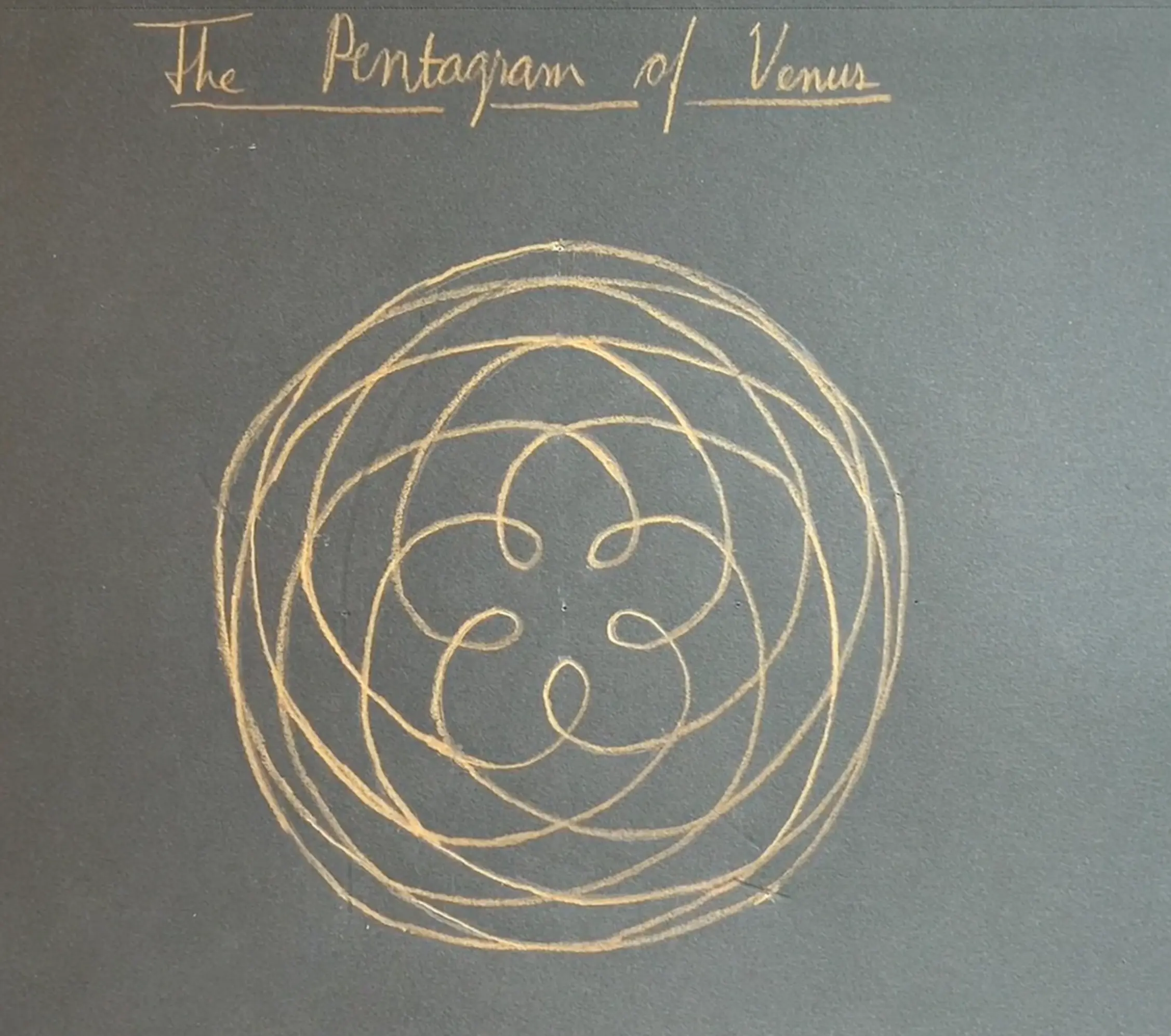
Here are a few examples. When we challenge our students to construct a pentagon within a circle (which is no easy task, I assure you) we can discuss the number 5 and how it relates to life. If the number 4 condenses creation into matter, 5 raises it into life. Is it any wonder so many plants have 5-petaled blossoms? Then, we can draw connections to astronomy through drawing the orbital, pattern of Venus – also a pentagram (and also very hard to construct). Here, we build the qualitative as we build the quantitative within our students. Math and science become then not just true but also beautiful. They become artistic, and what would otherwise be a dry subject takes on life.
Another example is business math, which we can teach in a way that fosters a sustainable economics. If we do it in a way that stokes our students’ selfishness and greed, however, it becomes a tool for egotism. If, on the other hand, we teach not just the math but the brotherhood principle in economics (with the goal of establishing a proper threefold social order in society), we teach them how to sustain people and planet through business. Then, the engine which is currently consuming the world will become that which sustains it.
A Values-Based Education
I don’t think it’s wise to sterilize values from education. That leaves a vacuity of heart that turns our culture into a wasteland for developing souls. Instead, we should consider what values are worth promoting. For my part, that will have to be a post for another time.
How to Connect
Enkindle Academy inspires young minds using a regenerative, Steiner-based approach to homeschooling. We offer prerecorded and live lessons for students in grades 5-9, encouraging students to deepen their reverence for nature and the living reality that permeates it. We teach all academic subjects plus creative writing and language arts, empowerment groups for teens, and soon to add fine arts.
Signup for a free sample lesson now.
References:
- Shakespeare, W. (n.d.). Hamlet (Act 1, Scene 5). Folger Shakespeare Library. https://www.folger.edu/explore/shakespeares-works/hamlet/read/
- Haidt, J. (2023, December 5). Why I’m increasingly worried about boys, too. American Institute for Boys and Men. https://aibm.org/commentary/why-im-increasingly-worried-about-boys-too/
- Kosmyna, N., Hauptmann, E., Yuan, Y. T., Situ, J., Liao, X.-H., Beresnitzky, A. V., Braunstein, I., & Maes, P. (2025). Your brain on ChatGPT: Accumulation of cognitive debt when using an AI assistant for essay writing [Preprint]. arXiv. https://doi.org/10.48550/arXiv.2506.08872
Leave a Reply
You must be logged in to post a comment.