
The political spectrum is highly divided right now, but one thing we can all agree on is ushering in a sustainable future for our children. Let’s start there. In pursuit of this goal, however, all aspects of human life require transformation: medicine, agriculture, economy, science, religion, and education, among others. In my opinion education is the beginning because inner and outer regeneration starts by planting the right seeds in children’s souls. Therefore, I will argue for a regenerative education approach in this post.
How Do We Deliver a Regenerative Education
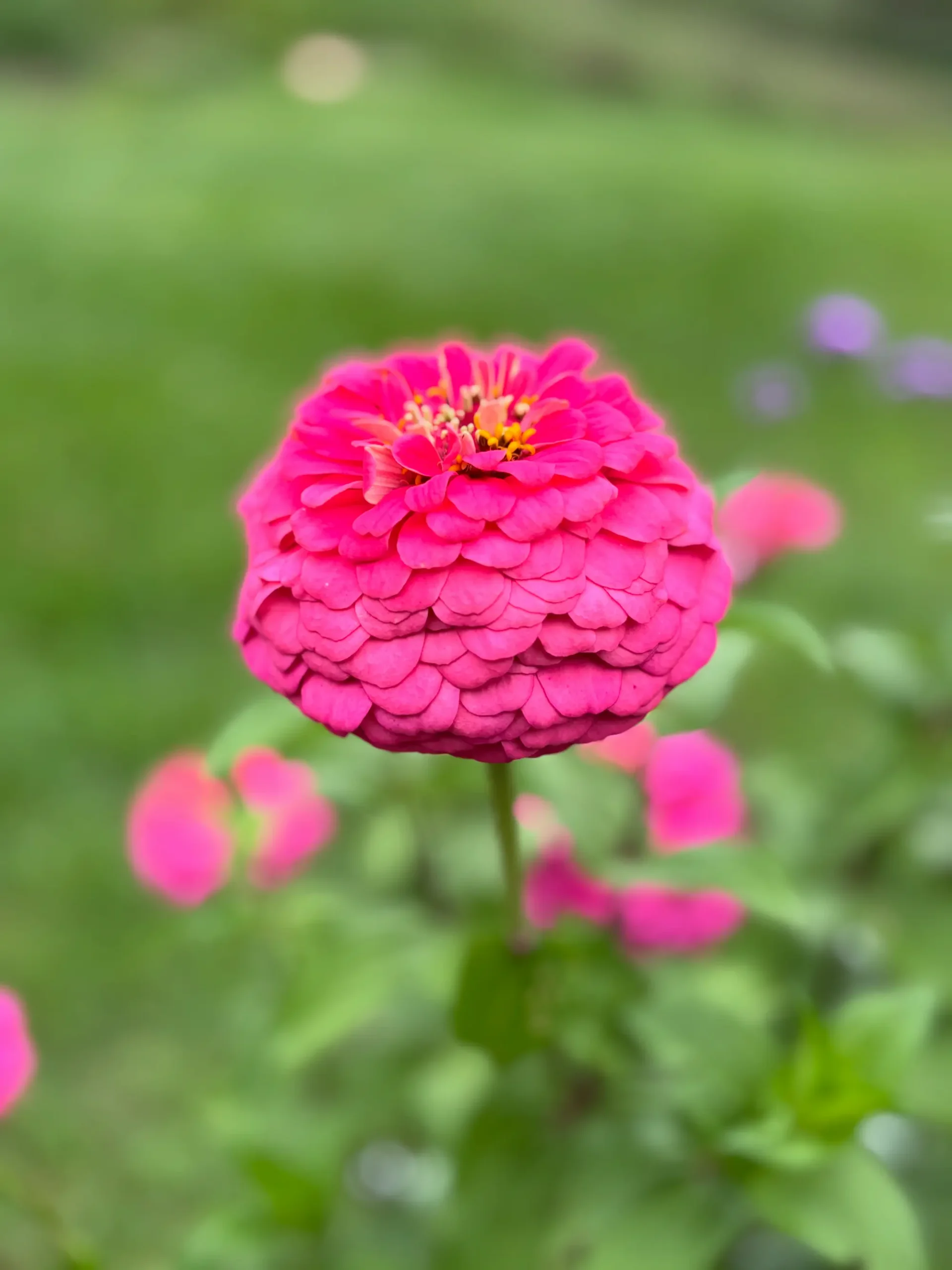
Such an approach starts by teaching youth in ways that re-enliven, not deaden, their thinking. It’s not just about teaching them to garden, for example, though that is also important. It begins with how we tend their soul life. Consider this picture. Let’s compare bombs and seeds. Both explode. The former explodes in destruction while the latter in creation. A bomb explodes through the combustion of volatile chemicals or through nuclear fusion or fission. It creates enormous destruction and chaos in the process. Seeds, by contrast, explode through life and growth. They combine and order dead matter, raising it into a life that even overcomes gravity. Look at the zinnia above. Imagine the blossoming, unfolding movements of its petals and you will intuit a similar pattern between it and a bomb. The product of a bomb, however, falls dead and chaotic towards earth. The product of a seed lifts towards the sun and then drops something orderly and capable of new life towards the earth.
This image doesn’t explain how regenerative education works – we will get to that shortly. However, I mention it because thoughts and images matter. They speak not only to the head but also to the heart. How we teach, and not just what we teach, makes a difference in how inwardly alive – or dead – our children become. In turn, this impacts what they do in the world.
The Crux of a Living Education
The crux of the matter lays in the heart. Ancient Greeks, Egyptians, and others believed we thought with our hearts. Rudolf Steiner confirmed this but explained that in the growing intellectualization of modern culture, this capacity has atrophied. We have forsaken heart for head.
A deeper understanding of physiology reveals the brain as the mirror, not the originator, of thinking. Thoughts become clear in the head, but the head does not originate them. Rather, the brain is like a dead mirror. As Steiner explains, “The experience of real, active thinking no more arises from the brain than the image of a face is created by the mirror.”1 When we as a culture emphasize head-activity, therefore, we purvey dead thoughts in our children. Is it any surprise our ultra-intellectualized culture has created so much toxicity and destruction in the modern world? We have generations of intellectuals who know nothing of living thought, only calcified, fossilized thought. They know only the veneer of reality and call it a totality. That will only change when we, as a culture, change course.
Steiner also explains that in modern times we are redeveloping the capacity for heart-thinking in a “spiritual organ that develops in the neighborhood of the heart, the twelve-petalled lotus-flower. This organ becomes a kind of organ of thinking in one who achieves inner development.”2 What ancient humanity instinctively felt, the humanity of the future will consciously develop. We are that humanity, thus why our education must speak not just to head but to heart as well.
Why Explosions Matter
Returning to our image of the bomb vs. the zinnia seed, I hope it’s clear why I used that. It’s a great way to explain to, say, middle schoolers, the difference between life-order-beauty-creation and death-chaos-ugliness-destruction. Images like that speak to the imagination and not merely the intellect. A truly regenerative education appeals to the imagination in age appropriate ways from early childhood through 12th grade, and arguably beyond.
We build such an education on spiritual scientific principles that not only teach them about the laws of the physical world but also about the artistic, orderly, and cosmic thoughts behind physical phenomena. Then, our children do not see a zinnia or rose as a mere reduction of chemical elements and genes, an arbitrary collection of amino acids that just “happens” as a kind of fortunate accident. Rather, the flower becomes for them an expression of living forces, terrestrial and cosmic, with a reality beyond the merely mineral – although, that is part of it.
They will arrive at such living concepts because we will have engaged their whole being – head, heart, and limbs – through imaginative pictures, artistic engagement, and phenomenological observation. They will have moved the forms of the flower artistically with their hands, charting them precisely with compass and straight edge revealing the Golden Ratio in its design and experiencing how this form connects with the orbital movements of Venus. Bring that into your gardening lessons.
Sowing the Seeds of a Regenerative Future
Sowing the seeds of sustainability starts with choosing the right regenerative education for our children. When we do so, we are not just enlivening their future but also that of all humankind and the earth as well. Such graduates will become the innovators of a bright, collective human future. Enkindle Academy sows such seeds by inspiring young minds using a regenerative, Steiner-based approach to homeschooling. We offer prerecorded and live lessons for students in grades 5-9, encouraging students to deepen their reverence for nature and the living reality that permeates it. We teach all academic subjects plus creative writing and language arts, empowerment groups for teens, and soon to add fine arts.
Signup for a free sample lesson now.
References
- Steiner, R. (1991). Human and cosmic thought (C. Davy, Trans.). Rudolf Steiner Press. (Original lectures delivered 1914).
- Steiner, R. (1968). Macrocosm and microcosm (C. Davy & D. S. Osmond, Trans.). Rudolf Steiner Press. (Original lectures delivered 1910).
Leave a Reply
You must be logged in to post a comment.