In the U.S., states will only fund secular education. This is seen as necessary to uphold the separation of church and state. It’s actually a violation of it, and I will address that in another post. However, that’s not the point of this post which is to ask, “What do we mean by a secular education?” How do we distinguish it from a religious or spiritual education? For that matter, what exactly do “secular” and “spiritual” even mean with regard to education?
I’ve asked many people this question recently, and the most common answer is “secular” means “non-religious.” In other words, it means not affiliated with any one religious tradition. Ok, so does that mean a “strictly materialistic” education, as in one that denies the reality of anything unseen? Or, does it mean agnostic, as in “We are open to the unseen but don’t know for sure which, if any, religions accurately describe it?” And, if secular means agnostic, is that agnosticism curious to find out if there is an unseen reality? Or, is it simply uninterested and, I daresay, even emotionally resistant, to the idea of even inquiring? (As I find so many materialists to be, these days.)
Even Secular Education Imparts a Paradigm
Education, like church, imparts a paradigm. There’s no avoiding it. The subjects that are taught, how they are taught, and the underlying assumptions of the teachers and curriculum materials, influence students one way or another. (In case you haven’t already guessed it, this is why government’s funding only government schools violates, not upholds, the separation of church and state. More on that later.) In government schools, the paradigm is the default materialist-scientific worldview. In an effort not to offend anyone nor speculate about anything beyond surface appearances, government education restricts the public curriculum to what merely senses see. On the other hand, in Catholic schools, you get the Catholic paradigm. In other forms of Christian education, you may even get Creationism.
(As a side note, Creationism is just as materialistic as materialism because it’s completely literal and unable to penetrate the Biblical creation story as imagery for contemplation. Creationism is just another way to bind oneself to the senses, albeit through words. Perhaps I will write a separate post about that sometime, too.)
Some of these things make me cringe, but it is nevertheless the case that curricula influence what students think. This is why I ask what a secular education truly is.
Phenomenological Science
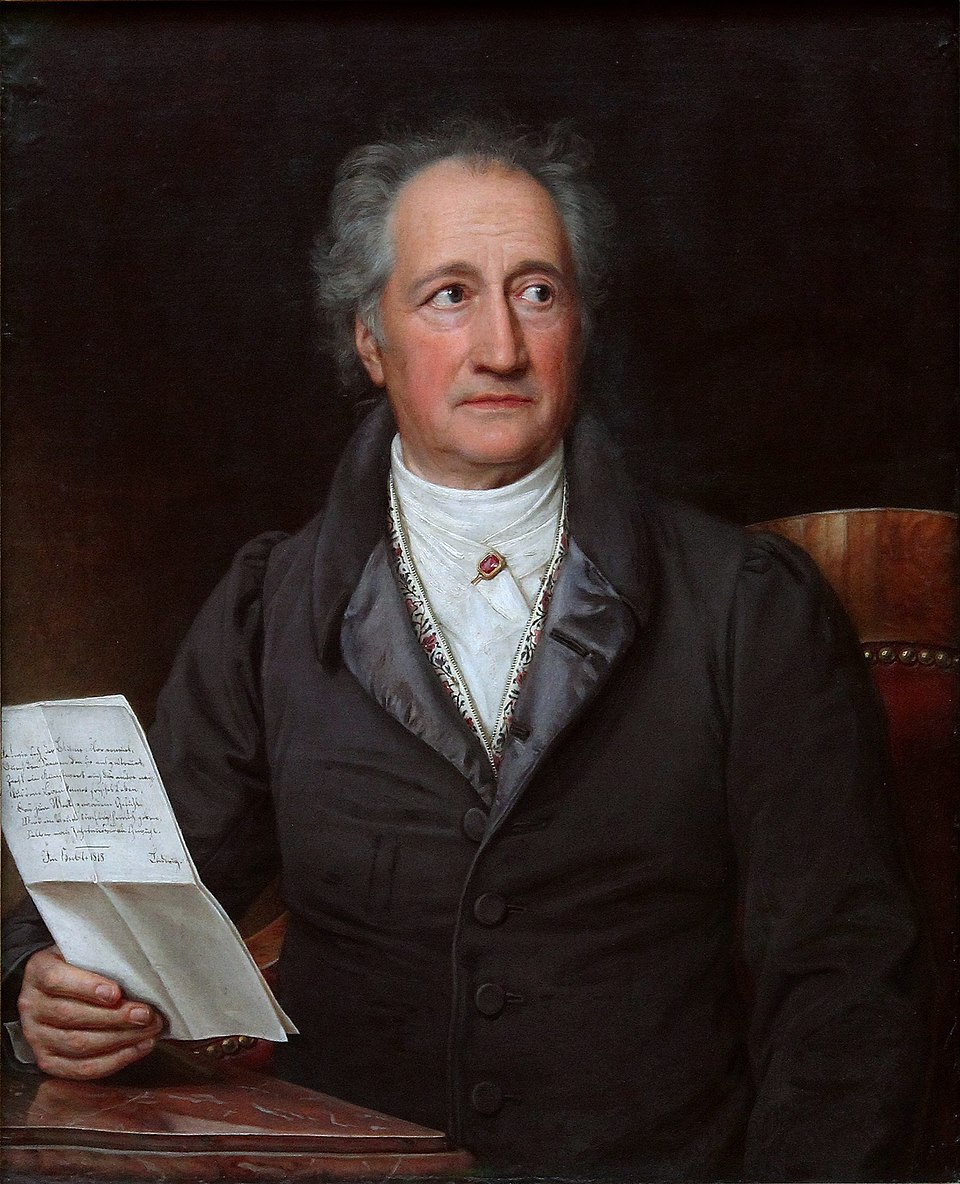
Johann Wolfgang von Goethe was a German poet, philosopher, playwright, scientist, and idealist, among other things. An intellectual titan of his time, Rudolf Steiner was perhaps his biggest fan. In addition to producing culture-informing works like Faust and the Green Snake and the Beautiful Lily, Goethe was an exemplary natural scientist. He gave a theory of color which increasingly rivals Newton’s, and he wrote an influential treatise on botany called The Metamorphosis of Plants.
Yet, Goethe’s abilities went further. Steiner describes him as being able to predict the weather days in advance without any of the modern technology we use today. In other words, Goethe had the ability to think thoughts that seemed to belong not just to himself but to the world. How could this be possible unless something unseen weaves through all the world’s phenomena of which we are included?
Steiner describes Goethe thusly, “Goethe’s world-conception is spiritual through and through.” Goethe’s fascination with natural science was not an impediment to the spirit, but rather an enhancement of it. Steiner goes on, “He sought the spirit not outside nature, but within nature itself…Goethe was convinced that the spiritual can be seen with the same certainty with which physical phenomena are seen, provided one develops the necessary organs of perception (Steiner, 1963, Chapter 1).” Goethe took a phenomenological approach to nature that led him to a holistic understanding that included both matter and spirit. It is an approach that anybody with the goodwill can replicate for themselves, thereby rendering it scientific. Would including Goethean science qualify as part of a secular education?
Is a Non-Denominational, Spiritual- Secular Education Possible?
We already said education imparts a worldview. However, what if it were a worldview of curiosity that included the freedom to teach about the possibility of realities unseen? What if, like Goethe, our paradigm went something like, “We find ourselves in a world full of riddles and puzzles we don’t understand. We rely on what our senses tell us. Yet, it may be possible to penetrate beyond the senses to something more, and we are going to experiment with it.” In other words, a non-denominational, yet scientific, approach to things both seen and unseen.
The History of Education
Public/Government education was championed in the United States by Horace Mann who admired the Prussian schools for many reasons, among them the obedience to authority and a standardized curriculum. He also believed education should be free, non-sectarian, and cultivate informed citizens (Ellis, Golz, & Mayrhofer, 2014). Mann’s intentions are admirable in evolving education from a neighborhood or church-based endeavor to a more standardized one with better quality control.
Yet, something is lost in standardization. You always run the risk of groupthink and conformity, and this can go in two directions. It either becomes religious or materialist dogma. In the case of American public education – which was further developed by industrialists like Rockefeller – it became the latter.
The Future
Is it possible to deliver an education which is both scientific and invites students to investigate, or at least be open to, the unseen? I want to plant the seed of a new way to see education, one that qualifies as “secular” in that it does not purvey any one religion over another, yet spiritual in that it takes an intensely curious, yet methodically scientific, approach to both seen and unseen realities. It should also be an education that, like Goethe’s science which includes the individual’s own personal experience, is not merely standardized. It should be a living education that doesn’t have to be one size that fits all.
How to Connect
Enkindle Academy offers prerecorded and live lessons for students in grades 5-9. We teach all academic subjects plus fine arts, creative writing and language arts, and empowerment groups for teens.
Our Creative Writing Class meets weekly. We are always accepting new students, and enrollment is growing rapidly. When we have enough students, we open up new sections. Visit us at the following link to signup or get more info: https://enkindleacademy.com/live-creative-writing-for-youth
Our Teen Empowerment Class also meets weekly. We are always accepting new students. If you want your youth in a tightly knit, warm, and welcoming group of peers with a loving guide who keeps them focused on the good, beautiful, and true come check us out. Visit us at the following link to signup or get more info: https://enkindleacademy.com/live-teen-empowerment-class.
Signup for a free sample lesson now.
References
- Steiner, Rudolf. Goethe’s Conception of the World. Chapter 1. New York: Anthroposophic Press, 1928.
- Ellis, A., Golz, R., & Mayrhofer, W. (2014). The education systems of Germany and other European countries of the 19th century in the view of American and Russian classics: Horace Mann and Konstantin Ushinsky. International Dialogues on Education: Past and Present, 1(1), 13–38. https://idejournal.org/index.php/ide/article/view/224
Leave a Reply
You must be logged in to post a comment.