In last week’s post, we focused on explaining how AI (artificial intelligence) functions. If we want to know how best to explain AI to our students, we have to start there. After all, being Luddites who dogmatically reject all technology out of hand won’t do us good. Our children will eventually become curious and open Pandora’s Box for themselves. It is better, therefore, that we prepare them through a proper education of what AI is and is not, as well as when and where it is and is not appropriate in human life. Last week, we understood the machine. In this post we will focus on what is human vs. AI. This post assumes you have read last week’s, so if you have not, start there.
Let’s get into this. AI runs on patterns and calculated logic. It transforms your questions (language) into numbers and uses that to calculate the response it thinks you want. The machine executes this according to patterns it has “learned” through the millions of data points it has been trained with. (Of course, it’s impossible to eliminate human bias this way. Whatever materials its human trainers have fed it influence the patterns it knows, but that is a post for another time.)
So, Does AI Think Like a Human?
In comparing what is human vs. AI, let us ask, is AI’s pattern-thinking human? Partly, yes. Little children, for example, learn their first concepts through pattern recognition. When my son was three, he knew what a car and a fan was. We called the fan an “upside down” because my mom used to hold him upside down so he could watch the ceiling fan in our house spin. The moment he saw his first helicopter, he looked up with great enthusiasm, pointing and proclaiming, “Upside down car!” In that both humans and AI recognize patterns and even combine them to form concepts, like upside down cars, our thinking is similar.
We differ in our bodies. A machine’s body is composed of dead minerals, and a dead body can never give rise to living thinking. AI can only know the past the use that to statistically predict the future. It can never know the exceptions to statistics (which we do through gut feelings and premonitions). AI is dead thinking on steroids.
By contrast, we are spiritual beings plugged into bodies that live, breathe, grow, heal, and feel. These vulnerable characteristics are the vessel for living thinking which is capable of intuition, new creation, and empathy. A human is not just a thinking being but also a feeling and willing one. Thereby, we can intuit why something matters to someone and do something about it out of our own selves. AI can never do that because it knows not why it matters. Humans can intuit, love, and act; AIs can only calculate.
Human Vs. AI: Why Can’t AI Ever Replace Humans?
Perhaps this is a rhetorical question. However, let’s unpack it further. Paracelsus recognized how patterns in nature resembled human organs. He was one of the first modern physicians to recognize this holistic correspondence between what lives inside and outside the human being. Paracelsus used this knowledge to treat illness. His work later became the basis for homeopathy and indeed much of modern medicine.
AI could never do that. Given a prompt, it might recognize correlative patterns, but the intuition that ties it all together into a coherent system of medicine would never occur to it. Such an insight comes from the spirit, alone. Once that intuition has dawned, a modern Paracelsus could use AI to help with pattern recognition by loading it with plant data from thousands of species. In such a case, AI becomes a tool to accelerate the development of what human intuition has already, well, intuited.
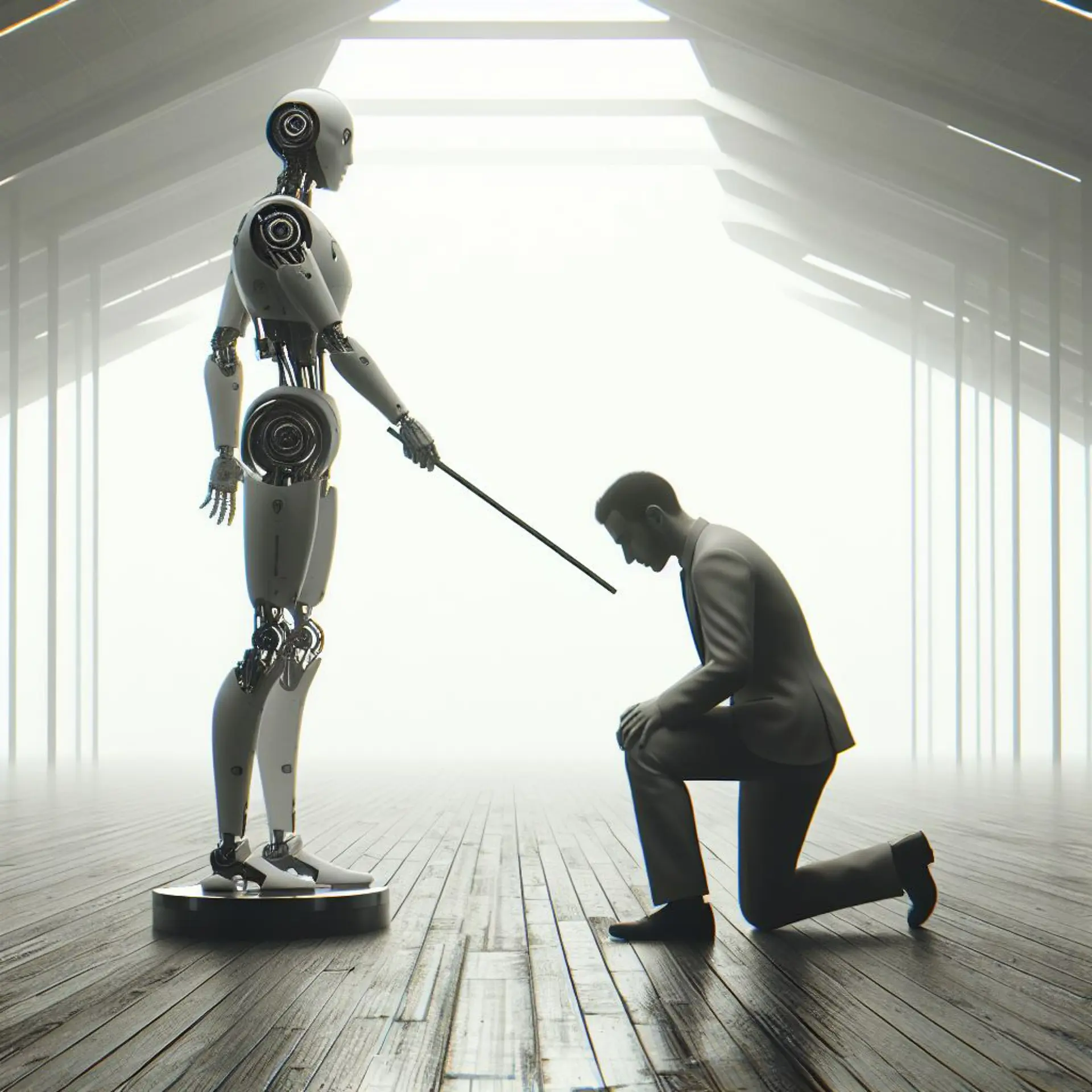
It goes without saying, therefore, that AI could never replace human beings. That being said, I hear some people talking these days about a symbiotic future where humans and machines coexist in harmony. In some respects, we already do, but does that mean we should elect machines to Congress? It becomes a question of who’s in charge and who is created in the image of who.
How This Matters for Educating Your Child
I once saw a high school eurythmy performance. Half the students were playing the part of humans and the other half machines. At first, the humans were having so much fun with the machines. The humans were playing with the machines and noticing how similar the machines acted like humans saying, “See how they’re like us!” As the performance continued, however, it took a darker turn. The humans started acting like the machines, and it ended on a very cold note with the machines saying, “No, see how you’re like US.”
You have to therefore ask yourself, do you want your children growing up becoming more human or machinelike? Put another way, do you want your children growing up with living or dead thinking?
I think that’s also a rhetorical question (at least, I hope so). Assuming it’s the former, their education should be multisensory. In addition to studying academic subjects like geometry, astronomy, algebra, history, geography, and so on, they should be learning handwork (knitting and crocheting), art, sculpture, how to play musical instruments, etc. A colleague once told me of a study showing that MIT grads of the smartphone generation performed just as well as their predecessors on standardized tests. However, they lacked the creativity of their forebears, and it’s all because they were raised on smart phones rather than getting their hands in the dirt, so to speak (and please forgive that I don’t have the reference for that study).
The Task of Humanity
In concluding this inquiry into what is human vs. AI, let us separate the tool from the tool maker. The task of the tool maker is not to become more like the tool. It is to use the tool to become a better tool maker. In the case of K-12 education, however, the tool is not even necessary.
The task of humanity is to recover in full consciousness its cosmically-gifted heritage: living thinking. AI represents the best of dead thinking, which has its place. Everything that relates to the past forms a foundation for what comes in the future. In that sense, AI is a phenomenal research tool. However, it can never attain the future because it doesn’t live and it doesn’t care. In explaining AI to your children, keep this in mind and help them understand why you don’t let them use it. They don’t need it at this age.
I once went to a doctor who spoke to me entirely in statistics and numbers. He did not see me at all and thus was completely ineffective at helping me. This man was creating himself in the image of the machine. Don’t be like him. Don’t be a tool. Raise your children to be tool makers by giving them a living education, not a dead one.
How We Can Help
Enkindle Academy offers prerecorded and live lessons for students in grades 5-9. We teach all academic subjects plus fine arts, creative writing and language arts, and empowerment groups for teens.
Leave a Reply
You must be logged in to post a comment.