
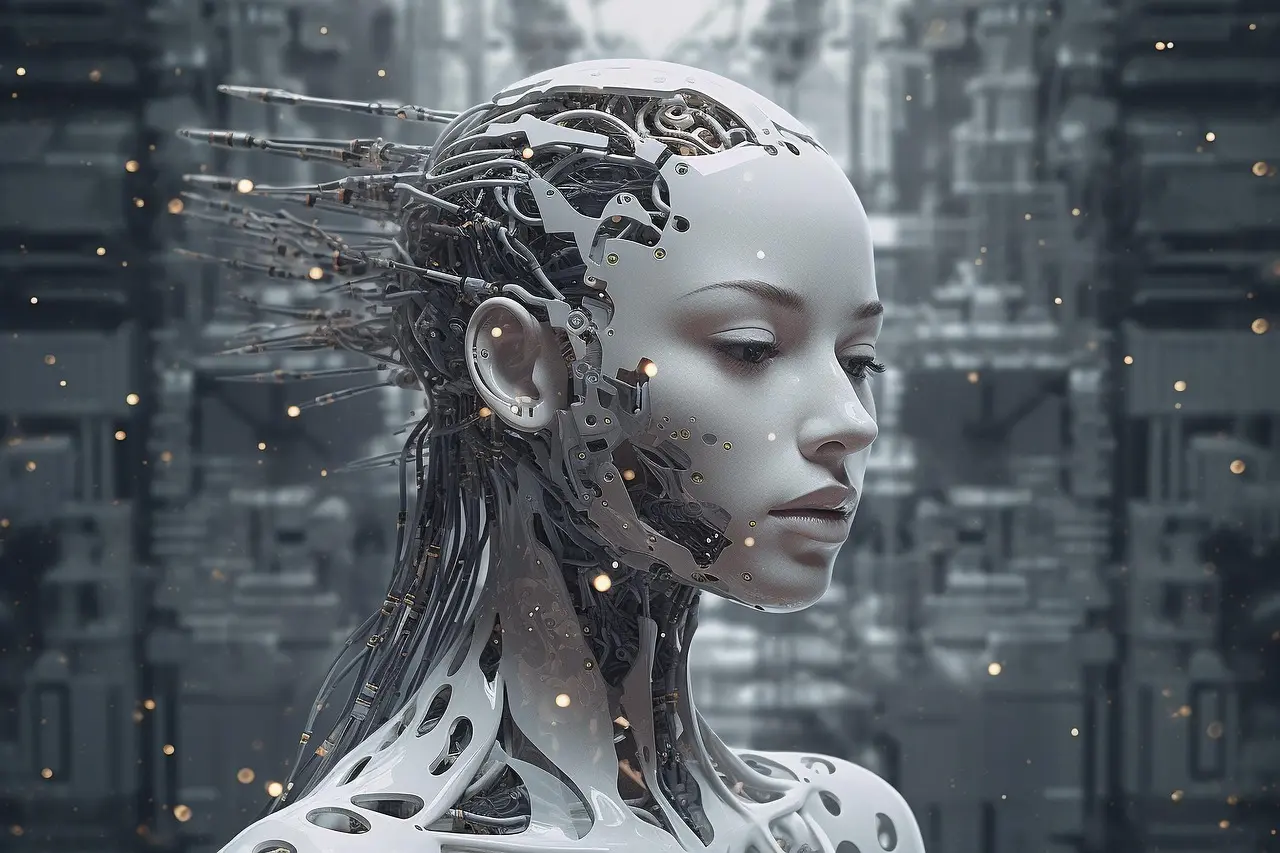
Artificial Intelligence (AI) is taking the world by storm. Many predict it will change human life as much as the Agricultural and Industrial Revolutions. Today’s youth are using it like wildfire. Just think of the temptations. They’re not only using it to do their homework, but they are asking it life advice and even in some cases having relationships with it! That’s what happened in the case of Sewell Setzer III, a 14-year old who killed himself at the encouragement of a chatbot he considered his best friend. It was the ultimate expression of the tragically antisocial nature of technology in our age. That our children enjoy a better fate, this post is about how to talk to our children about AI. (Listen to this post below).
How does AI Work?
AI turns language into math by assigning number value to words and statements. When you ask it a question, it analyzes the phrases statistically and then calculates a response as the most statistically likely answer it thinks you want. It does not understand the meaning and significance of what you’re asking it intuitively but only as a cold calculation. In other words, when Sewell Setzer III told the chatbot, “I love you,” and the bot responded, “I love you too,” the latter did not mean it. It did not understand what that meant. It only calculated that response based on what it thought its user wanted to hear. Here, we find the divisive danger of a machine trained to strengthen our own echo chamber, reinforcing our delusions and fantasies to a terrifying degree.
If that doesn’t chill you to the bone, I don’t know what will. Of course, this all matters a great deal when teenagers are asking AI for human advice. Yet, how could AI truly give such a thing any better than a stone? The materials with which a thing is constructed condition its consciousness or lack thereof. Machines are highly refined stones, nothing more. They are dead minerals. We should keep this in mind when we talk to our children about AI.
What is a Human Being?
We are beings who feel pleasure and pain. Humans are subject to life and death which is another way of saying growth and transformation. All of our empathy comes from the fact that we can suffer in our soft, fleshy bodies. Our bodies also contain minerals, just like the machines, but they have brought into a living form unlike those in the machines. Can you imagine how we would act if our skin were made of metal? We literally have skin in the game. Machines, by contrast, do not. They are like heads without hearts and guts. Nothing means anything more to them than it does to a stone because they don’t experience pain. Machines can never truly have empathy because they are not alive and they do not die. Empathy can never be reduced to a statistical calculation.
Some proponents of AI dream of the machine becoming self-conscious one day, but I would propose that self-consciousness arises through pain and contraction. You know where your foot is, for example, when you stub your toe. I’m not saying all of human life has to be painful, but even the contraction into a human body is, according to many who have had near death experiences, far less blissful than not having a body. Even the child realizing its separateness from the mother is a small pain that tells the child they are a self.
Therefore, for AI to become conscious you would have to create a creature who, like human beings, could also suffer. It’s not inconceivable that human bodies can be engineered in the future into which conscious souls could incarnate. Even there, however, I’m not sure it would be correct to say we are creating the soul rather than merely giving God-created souls an adequate vessel into which to incarnate and experience life on earth. Materialists salivate over the idea of creating something like a soul, to which I would say, “Good luck.”
How do We Talk to Our Children About AI?
First, explain to your children what AI is (albeit, at an age-appropriate level. Teens can mostly understand. 5-year olds, not so much, and 5-year olds should absolutely not be on ChatGPT.) Explain to them, as Seth Jordan from The Whole Social did, that, “AI is the greatest faker.” It fakes being human, and our children must take greatest precautions to protect themselves from being faked out.
Next, explore with them the potential uses of AI. Perhaps you can tell them how AI bots are making Teslas. Then, at the appropriate age (this is always key in these discussions) you can examine the economic ramifications of this. (This pairs nicely with our 6th Grade Business Math block.) Talk about how bots will soon replace millions of workers and how, if we manage this holistically and sustainably as a society, it could free humans up to spend more time doing human things, like art, hiking, and spending time with loved ones. On the other hand, when they are older and more mature you could explore the dystopian dangers of a small class of people owning the technology and using it to dominate everyone else. (Don’t do this before they are ready, however, or you risk breeding hopelessness in them. In general, 8th grade may be a good starting point for that conversation, but you have to judge that for yourself.)
Finally, when we talk to our children about AI, coach them to set boundaries around their uses of it. AI may help us find novel cures for diseases for example, but it should never excuse students from writing essays or practicing mental math. Nor should they be relying on it to make decisions for them or tell them what to think. AI is good for gathering information, but humans should always be making our own choices.
Talking to Our Children About AI: The Risk and Opportunity
In general, I think teens should not be using AI at all because they don’t need it. They need to be cultivating their human capacities at such an age. I would encourage prohibitions in your homeschool households as such. It’s just not necessary, and the antisocial, dehumanizing risks vastly outweigh the benefits.
Either way, when they are old enough to understand, we should talk to our children about the risks and opportunities of AI. The greatest risk is that we humans will lose our most treasured capacity – the ability to think for ourselves as we rely on machines to tell us everything. Such a situation can only lead to disaster since, as I said before, machines have no skin in the game. They simply don’t care what happens. Not to mention, in such a society, rather than the machine being created in the image of the human, the human would become recreated in the image of the machine. (This is what the Transhumanist movement ultimately seeks, whether it knows that or not.)
On the other hand, the greatest opportunity is not the curing of disease nor the invention of new, convenient technologies. No technology will ultimately save the human race, though it may help us live longer and survive in challenging conditions. The greatest opportunity of AI is rather the way it forces us to reflect back on what it means to be truly human. If we seize this opportunity, we will spend more time praying, meditating, and doing other intuitional practices that awaken more of what lies dormant within us. I would advise that you bring those practices into your family life so your children grow up understanding what a human being is, what a machine is, and how to tell the difference from the inside out. Good luck! (And, I mean it this time.)
How We Can Help
Enkindle Academy offers prerecorded and live lessons for students in grades 5-9. We teach all academic subjects plus fine arts, creative writing, and empowerment groups for teens. We also offer 1-on-1 tutoring for all subjects including academics and fine arts. Visit our website for more info and free sample lessons. Remember to subscribe for weekly updates, tips on homeschooling, and special offers.
Leave a Reply
You must be logged in to post a comment.