
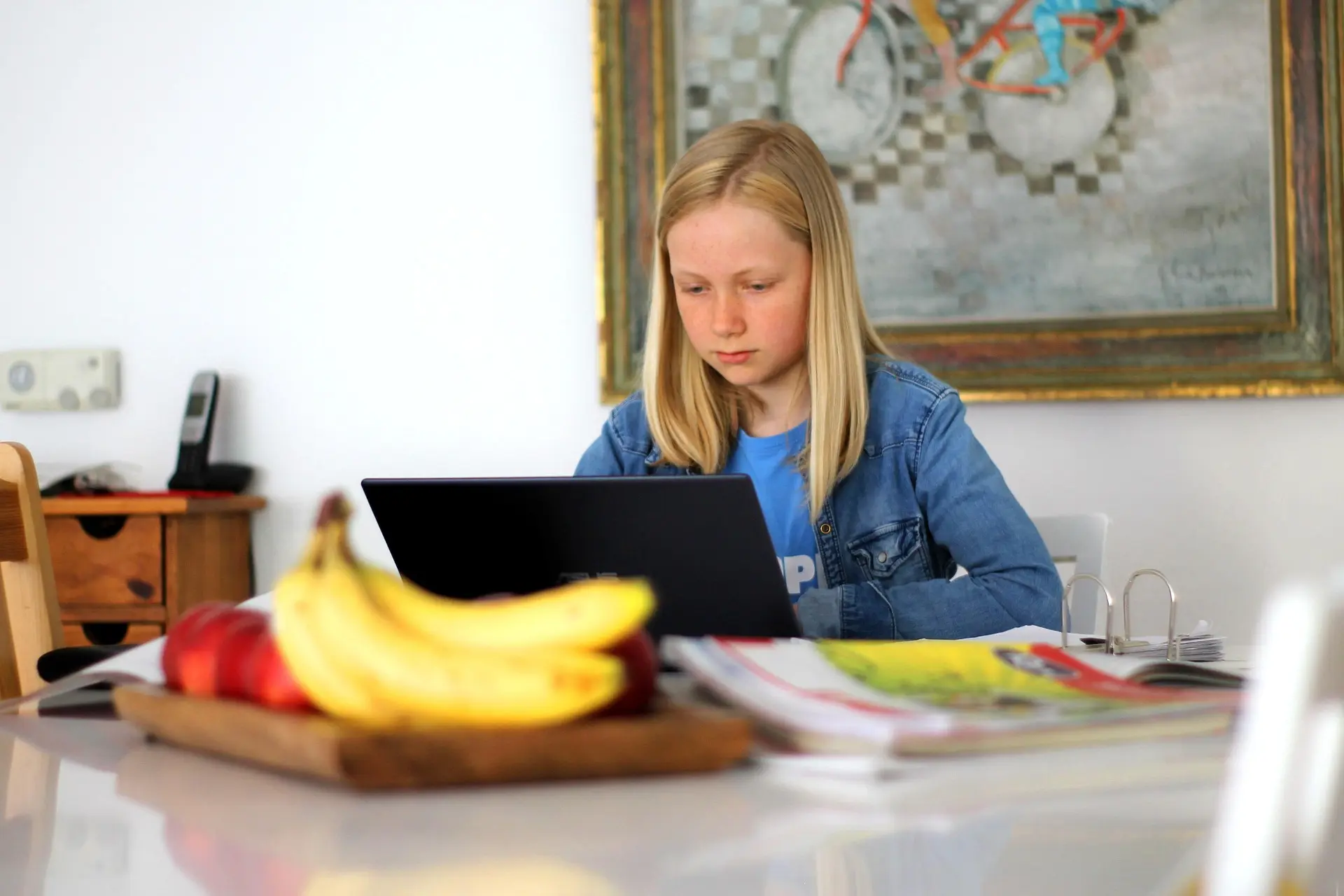
Homeschoolers have a variety of curriculum options these days. Some of them are DIY written curriculum while others, like ours at Enkindle Academy, are more interactive. However, as every homeschooler knows, having the right curriculum is not enough. There’s a lot more that goes into your day, and today I want to talk about your daily homeschool rhythm. Later, I’m going to give you access to a free guide for how you can structure your days for best results, but let’s first set the groundwork.
Rudolf Steiner explained to the teachers of the first Waldorf School that one of the most important tasks of education was teaching children how to breathe.1 When we say “daily homeschool rhythm,” therefore, we mean how your child breathes through the day. This is less about physiological breathing than soul breathing because the soul leads the body. It is, therefore, more a question of the breathing of thinking, feeling, and willing. In other words, activities that dance between focus and relaxation, contraction vs. expansion, sitting still vs. moving, etc. This gentle and intentional movement between polarities is a healing impulse. It can also work wonders for children who struggle with ADHD and other neurodivergent challenges.
So, How Do We Create a Daily Homeschool Rhythm that Breathes?
There is no formula that works for every child in every family. I give specific suggestions in the free guide: The Rhythms of Health in Education. However, my goal is rather to create a pedagogical instinct in you so you don’t need a guru to tell you what to do. You can create it for yourself. First, think about the whole day like a composition of music. In general, the nighttime is like a giant out-breath where consciousness flies free and unconscious in the starry heavens. The day, by contrast, is a giant in-breath where consciousness incarnates and awakens.
This daily rhythm of incarnation and excarnation, however, happens gradually and not all at once. It starts at the top with the head in the morning, proceeds through the torso in the late morning, and pushes down into the limbs by the afternoon. Then, the process reverses and goes back the way it came. That’s why it’s ideal to do:
- Headier, more thinking-focused activities in the morning
- Rhythmic activities like music, arts, and language practice in the late morning
- Sports and movement in the afternoon.
This is also why practicing an instrument can work well in the early evening (which is the mirror of the late morning) and reading, which is more contemplative, can happen at night. (Although reading is more of a passive intellectual activity. I would highly recommend against math and other mentally exerting activities at night because the mind is also tired by then.)
At the same time, within each section of the day, there needs to be breathing. So, for example, if you start with main lesson in the morning, send them outside for fresh air before their violin lesson at noon. Then, have lunch and let them rest before they stack firewood in the mid-afternoon. After that, they can come in and play a board game with siblings, have dinner, do chores, and then read before bed.
No Dogma, Though
These indications are born from my own experience as an educator and human being. They are not meant as dogma but as guides with which to experiment and build your own instinct from. You need to do your own experiments.
Why Rhythm Matters So Much
If you read through the example sequence above, you can sense the rhythmic nature of it – activity and stillness, contraction and expansion, focus and relaxation – as it harmonizes with the larger daily rhythm of incarnation/excarnation. Our whole lives consist of rhythms nested within rhythms nested within rhythms. We can even see earth life as in-breath and earth death as out-breath. (Some people also call “death” as “the life between lives.”)
Understanding and consciously working with this knowledge matters because breathing is healing. The cardiovascular and circulatory systems, collectively known as the “rhythmic” system because of their rhythmic nature, are the healers of the body. When people get sick, it can often times be traced to poor or irregular circulation or disruptions in the breathing process. For example, anxiety occurs when there’s too much in-breath, while depression when there’s too much out-breath.
When we teach our children to breathe properly, it brings health to their lives. However – and this is very important to understand – we are not training them to breathe physiologically because that can bind them too strongly to the body, interestingly enough. We have to work in a subtler way when they are young. We are teaching their souls to breathe through a breathing of activity. This then translates into a healthier physiological breathing, but there’s no need for special breathing exercises. The body follows the mind, so when the thoughts breathe, the body breathes. This process also trains their sense of life which proves critical later in life.
How This Applies to You
As I suggested earlier, much can be accomplished through establishing a proper breathing process in your child’s day, even for those with various challenges. Generally, I find industrially-based schedules of public, and even most Waldorf, schools to be naturally aggravating to conditions like ADHD. These facts make homeschooling a natural fit for children who struggle and even for those who don’t due to the possibility of creating life-giving routines.
The blessing is that you get to do it in your own way. That doesn’t make it easy, though. The same characteristic that gives you the freedom to educate your child as you please simultaneously requires you to step up and become the pedagogical intuitive they need. If you already homeschool, you may be reading this and thinking you’re in the proverbial choir to whom I am preaching. In which case, you are welcome to utter the proverbial “Amen!” or, like me, take a continuous and deeper look at how you’re already structuring your days. Study your children and see how well the existing rhythm is working for them. Homeschooling is a continuous meditation.
For example, if like me you have a young child who loathes rest time of any kind, the challenge becomes how to set it up creatively to get around the resistance. Maybe include a story and show him or her how their stuffed animals are quite tired and need a nap. Then, ask your child to tuck them in and lay with them as mommy and daddy lay with the child when they’re falling asleep at night. You have to think about these things for yourself and figure out how to creatively apply it to your child. It can be hard work, but it is definitely worth it, and your child will thank you later in life.
Free Daily Homeschool Rhythm Guide
And, now for that free guide I promised. You can download it by signing up for our free weekly email newsletter here: https://enkindleacademy.com/rhythm-guide-signup.
How We Can Help
Enkindle Academy offers prerecorded and live lessons for students in grades 5-9. We teach all academic subjects plus fine arts, creative writing, and empowerment groups for teens. We also offer 1-on-1 tutoring for all subjects including academics and fine arts.
Signup for a free sample block now.
References:
- Steiner, R. (1919/1966). Study of Man (Lecture I, August 21, 1919; GA 293). In D. Harwood & H. Fox (Trans.), Study of Man (pp. 1–…). Rudolf Steiner Archive. https://rsarchive.org/Lectures/GA293/English/RSP1966/19190821a01.html
Leave a Reply
You must be logged in to post a comment.